
Vocabulary Instruction & Intervention for Grades 3–8
Vocabulary is the strongest predictor of reading comprehension — students need to understand about 98% of a text's words to grasp its meaning. For grades 3–8, the most effective vocabulary instruction moves beyond memorized word lists to teach Tier 2 words through visual, meaning-based reasoning that mirrors how students learn words from wide reading. With our cutting-edge visual vocabulary approach, students build the robust language skills they need to excel and truly understand and enjoy reading.
Rethink Vocabulary Instruction: A Research-Based Breakthrough
Discover why traditional word lists fall short—and how InferCabulary is helping students learn vocabulary 3–4x faster through visual, engaging, and scientifically grounded methods.
This new vocabulary paper reveals how InferCabulary transforms word learning by using semantic reasoning, multimodal input, and deep contextual engagement. Built on cognitive science and classroom results, it’s a smarter way to build lasting vocabulary.
InferCabulary strengthens learners’ ability to understand the deeper meaning of texts, cultivating the robust vocabulary necessary for academic success. The program boosts vocabulary acquisition, a critical skill for reading comprehension, and replicates the benefits of a rich oral language environment.
- Whole class, supplemental instruction and intervention for Grades 3-12
- Supports independent acquisition of Tier 2 vocabulary
- Enhances oral language, inferencing skills, and background knowledge
- Three 20-minute sessions per week, or 10 minutes daily

- Mimics the experience of wide and avid reading as the result of multiple encounters in a variety of tasks over time
- Promotes deep word learning as students encounter Tier 2 vocabulary in various contexts
- Learners are immediately engaged with real-world images that reflect the nuanced meanings of each vocabulary target
- Students learn through evidence-based strategies, including semantic reasoning, embodied cognition, and extended mapping
- Teachers select vocabulary from a broad library of 500+ literature titles and a variety of word categories, such as 600+ SAT words, that can be tailored to specific goals
- Educators can utilize portions of texts from other literacy sources to create word lists
- Effective for general education, ELs, and students with learning differences
- Students gain control over their vocabulary growth, enhancing their confidence in reading, fluency, comprehension, and written expression
- Encourages students to analyze patterns, connect with their own background knowledge, and engage in critical thinking while learning new words in a visually engaging, supportive learning environment
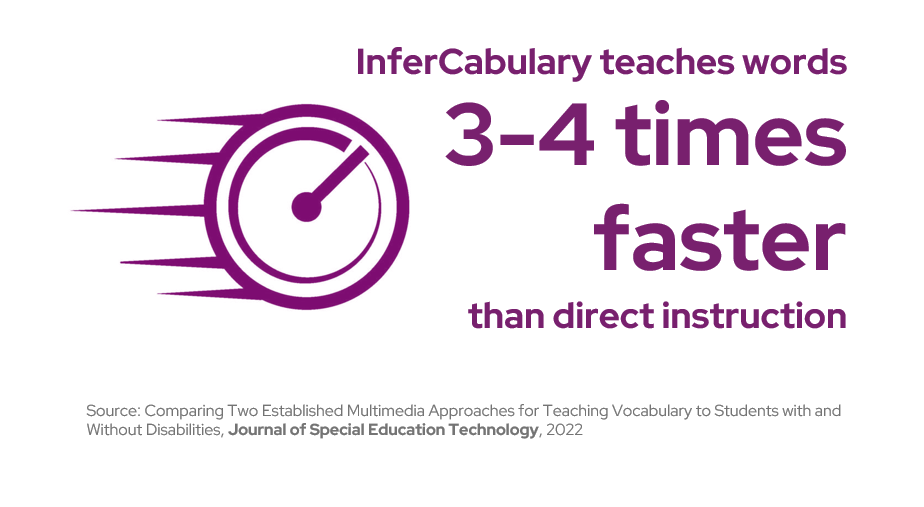
Students using InferCabulary in a large-scale, multi-state 2022 study were able to learn more words, 3-4 times faster than students who participated in direct instruction groups. This proved true for students with diagnosed learning disabilities, students in RTI, and those who do not struggle.
The study revealed that students who used InferCabulary independently outperformed general education students who had received business-as-usual instruction.
Young people are reading less and failing to build vocabulary amid a sea of text messaging and cyberchat says literacy and child development specialist Professor Tom Nicholson. It goes without saying that the best writers and speakers are often the widest readers. Today’s kids have been raised on computers, iPads, and television, so it’s important to encourage them to build their vocabulary.

How do you ensure you’re providing rigorous, or “best practice”, vocabulary instruction? Though it is not an exact science, research supports that a few key components are effective in vocabulary instruction.
What variables have decades of research identified that impact the ease or difficulty of learning and remembering vocabulary words? Some of these factors include:
- the length of the word (longer words often have more complex spelling)
- the frequency of the word in the language (i.e., how often it is used in speech or in print)
- the degree of abstractness of the word (e.g., “theory” vs. “car”)
Join us for a free Vocabulary Virtual Workshop and learn all about bringing the Vocabulary Science of Reading to life in the classroom!
- Learn the science behind how students engage with and learn vocabulary critical for all reading fluency and comprehension.
- Receive a certificate of attendance after attending this 3-hour webinar.

InferCabulary is a visual vocabulary tool that teaches Tier 2 vocabulary using a unique, highly efficient approach that mimics the act of wide reading as students encounter word meanings in a rich, oral language setting.
What is the best vocabulary program for grades 3–8?
Effective grades 3–8 vocabulary programs teach Tier 2 academic words through repeated, meaningful exposure rather than isolated word lists. InferCabulary uses visual, semantic-reasoning tasks so students infer meaning the way they would from wide reading.
What is a supplemental vocabulary program?
A supplemental vocabulary program adds targeted word-learning to core instruction without replacing it — used in whole-class, small-group, or intervention settings. InferCabulary runs in about 20 minutes, three times a week, or 10 minutes daily.
How do you teach vocabulary to struggling readers?
Struggling readers benefit from multiple, varied encounters with a word and from visual supports that reduce reliance on decoding. Meaning-first, image-based instruction lets students build word knowledge even when text access is limited.
Why is vocabulary central to reading comprehension?
Comprehension depends on knowing the words in a text — students need to understand roughly 98% of a passage's words to fully grasp it. Weak vocabulary caps comprehension no matter how strong decoding is.
What is InferCabulary?
InferCabulary is a visual vocabulary tool that teaches Tier 2 words for grades 3–8 using real-world images and semantic reasoning, replicating the word-learning that happens in a rich oral-language environment.
How is visual vocabulary instruction different from word lists?
Word lists pair a term with a single definition; visual instruction shows a word's meaning across multiple images and contexts, which research links to deeper retention and transfer.