
Middle School Reading Intervention for Grades 6–8
Support middle school students with targeted, age-respectful reading intervention that addresses specific skills across word reading and language comprehension.
Middle school students encounter increasingly complex words, academic vocabulary, sentence structures, and ideas across every subject. As students strengthen the reading skills they need, they are better positioned to engage with the texts, concepts, and knowledge they encounter in ELA, science, social studies, math, and other classes.
For some students, that may mean greater accuracy and automaticity with complex words. For others, it may mean stronger morphology, vocabulary, or language comprehension. Many students need support across more than one area.
As reading proficiency grows, students gain greater confidence and independence, giving them greater access to learning throughout the school day.
Middle school students who need reading support come to the classroom with different combinations of strengths and skills still developing. Screening can help identify who may need additional support, while diagnostic information gives educators a clearer picture of what each student can already do and where additional instruction is needed.
A student’s reading profile may include needs in one or more areas:

Reading needs evolve as students develop new literacy skills. Regular progress monitoring gives educators, coaches, principals, and district administrators a clearer view of how students are responding to instruction and where support needs to shift.
Educators can use this information to:
- Continue instruction when students are making expected progress
- Adjust the instructional focus as new skills develop
- Regroup students as their needs change
- Increase or decrease the intensity of support when appropriate
RGR helps teams keep assessment, instruction, and progress information connected so intervention can remain responsive over time.
Middle school students may still need explicit instruction in foundational reading skills. They also need instruction and materials that reflect their maturity, knowledge, and the increasingly complex reading they encounter throughout the school day.
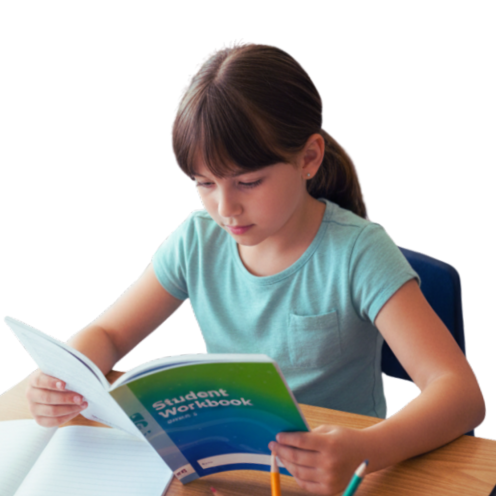
Targeted, teacher-led intervention helps educators address the skills each student needs to strengthen, from advanced word reading and fluency to morphology, vocabulary, and language comprehension, within an age-respectful instructional approach
Age-respectful decodable chapter books give students structured opportunities to apply developing phonics and word-reading skills in mature, engaging text created for adolescent readers.
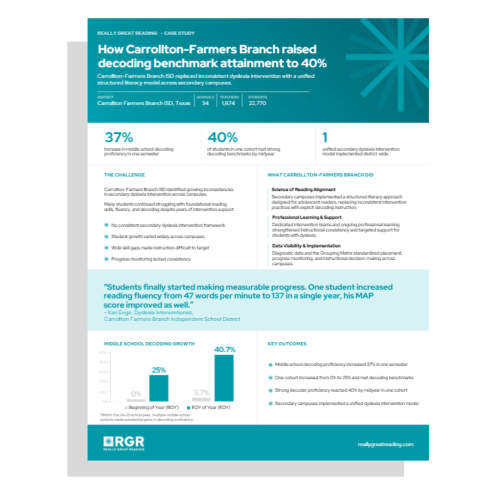
Carrollton-Farmers Branch ISD used diagnostic information, targeted grouping, consistent Structured Literacy instruction, protected instructional time, and progress monitoring to strengthen secondary dyslexia intervention.
In one middle school cohort, the percentage of students meeting decoding expectations increased 37 percentage points in one semester.
The district’s experience shows how clearer information about student needs, consistent instruction, and attention to student progress can support meaningful growth for older readers.
Middle school intervention has to work within real schedules, staffing models, budgets, and Multi-Tiered System of Supports (MTSS) structures. RGR connects assessment, targeted intervention, professional learning, and progress monitoring within one integrated system.
That gives educators and leaders clearer information to support decisions about instructional focus, student grouping, and intervention intensity while preserving professional judgment and the systems already serving students.
What is middle school reading intervention?
Middle school reading intervention provides targeted instruction for students in grades 6–8 who need additional support with reading. Because students come to intervention with different combinations of strengths and skills still developing, instruction may focus on word reading, fluency, language comprehension, or multiple areas.
Educators can use screening, diagnostic information, and progress monitoring to understand student needs, target instruction, and make informed decisions over time.
What should schools look for in a middle school reading intervention program?
Schools should look for middle school reading intervention that helps educators identify specific student needs, provides explicit instruction matched to those needs, uses age-respectful materials, and includes progress monitoring.
For older readers, intervention may need to address advanced phonics, multisyllabic word reading, automatic word recognition, fluency, morphology, vocabulary, language structures, or comprehension. The instructional focus should reflect each student’s reading profile rather than assume every student needs the same support. The intervention guide similarly emphasizes that older students may have needs in word recognition, automaticity, language comprehension, or a combination.
How do educators determine what type of reading intervention a middle school student needs?
Universal screening can help identify students who may need additional reading support. Diagnostic follow-up gives educators more detailed information about the skills contributing to a student’s reading performance.
That information can help teams understand whether a student needs support with word reading, fluency, language comprehension, or needs across multiple areas. Educators can then use professional judgment and progress information to determine the appropriate instructional focus. The intervention guide specifically distinguishes broad screening from the more actionable information diagnostic assessment provides for intervention planning.
Why can a student read the words but still struggle to understand the text?
Accurate word reading is an important part of reading comprehension, but students also rely on vocabulary, background knowledge, morphology, language structures, and other language-comprehension skills to make meaning.
A student may therefore read words accurately and fluently while still needing support in understanding academic vocabulary, complex sentences, relationships among ideas, or the meaning of a text. The intervention guide identifies language comprehension as a distinct area of need for some older readers.
What does Science of Reading-aligned intervention look like in grades 6–8?
Science of Reading-aligned middle school intervention uses evidence about how reading develops to help educators identify and explicitly teach the skills each student needs.
Depending on the student’s reading profile, instruction may address advanced phonics, multisyllabic word reading, fluency, morphology, vocabulary, language structures, or comprehension. Educators can then use progress information to understand how students are responding and refine instruction over time.
What should Tier 2 reading intervention look like in middle school MTSS?
Tier 2 reading intervention within a middle school Multi-Tiered System of Supports (MTSS) should provide targeted instruction based on identified student needs.
Teams can use screening to identify students who may need additional support, diagnostic information to clarify which skills to prioritize, and progress monitoring to understand how students are responding. The specific instructional response will depend on the student as well as the school’s available intervention time, staffing, and existing MTSS structure.
How can Structured Literacy support middle school students with dyslexia?
Structured Literacy provides explicit, systematic instruction in the components of written language. Middle school students with dyslexia may need support with different combinations of phonological processing, phonics, decoding, spelling, automatic word recognition, multisyllabic word reading, and fluency.
Diagnostic information helps educators identify which skills need focused instruction and determine the appropriate pace and intensity of support.