
Indiana’s Middle School Reading Challenge Cannot Wait
Indiana has made meaningful progress in early literacy. But for students already in middle school, the window to close persistent reading gaps is narrowing.
In 2026, fewer than half of Indiana students in Grades 6–8 reached proficiency on ILEARN ELA.
Through Indiana’s Outcomes-Based Literacy initiative, RGR helps school corporations identify older readers’ needs and implement targeted, Science of Reading-aligned intervention focused on measurable outcomes.
Evidence-backed literacy instruction, independently reviewed outcomes, and proven approaches school corporations can trust.

2026 ILEARN ELA proficiency rates in the middle grades:
- Grade 6 ELA: 41.3%
- Grade 7 ELA: 41.7%
- Grade 8 ELA: 44.0%
By middle school, reading difficulty can stem from a combination of skills. Identifying what reading skill is blocking each student helps educators deliver targeted instruction needed for effective intervention.
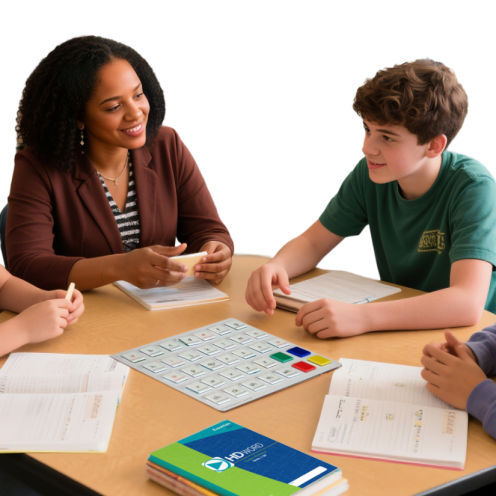
Older readers with persistent literacy gaps need more than additional practice. RGR helps Indiana school corporations identify what is blocking each reader, deliver targeted instruction, and support educators in turning intervention into measurable progress.
Through Indiana’s Outcomes-Based Literacy initiative, RGR is partnering with four Indiana school corporations to put an outcomes-focused approach to literacy intervention into practice.
Together, these corporations are combining targeted intervention, strong implementation, and shared accountability to drive measurable student outcomes.
40% of RGR’s contract value is contingent on validated student outcomes, with third-party validation from Harvard University’s Center for Education Policy Research.


"I had a student who fought me for months. The next year she asked specifically to return to my class. She now tells other kids, 'Do this. It works."
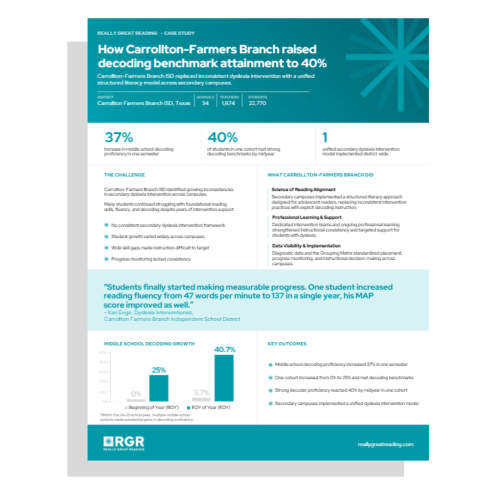
Carrollton-Farmers Branch ISD needed a stronger approach for older students receiving dyslexia services who continued to struggle with foundational reading skills.
The challenge:
Students needed explicit intervention aligned to persistent decoding gaps across the district’s secondary campuses.
The approach:
Carrollton-Farmers Branch implemented targeted RGR intervention focused on the decoding skills students had not yet mastered.
The result:
Decoding proficiency increased by 37 percentage points in one semester.
Choose the path that best fits your corporation’s literacy priorities, timing and procurement needs.
Start Now Through Your Existing Procurement Process
Bring RGR intervention and professional learning into your schools using your existing purchasing process.
Explore a Direct Outcomes Based Contract
Work directly with RGR through an outcomes based partnership built around shared responsibilities and measurable student results.
Prepare for Future State-Funded Opportunities
Build the staffing, schedules, and implementation practices needed for future Indiana outcomes based opportunities.

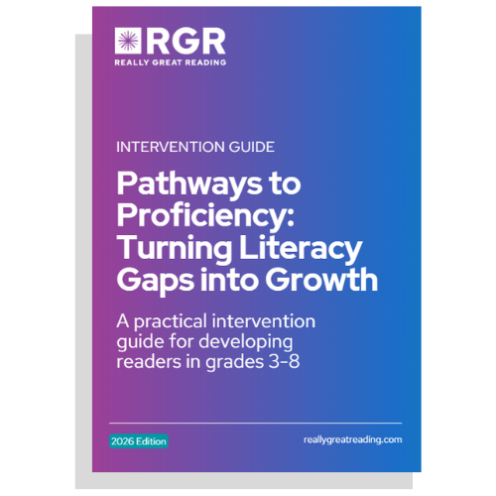
FREE GRADES 3–8 INTERVENTION GUIDE
Pathways to Proficiency gives elementary and middle school leaders a practical framework for identifying student needs, matching intervention to the skill gap, and building responsive intervention groups.
Inside the guide:
- Four developing-reader profiles
- What universal screeners may miss
- A practical placement pathway
- Guidance for Grades 3–5 and 6–8
- A responsive monitoring and regrouping model

Strong intervention depends on strong implementation.
Indiana’s literacy work is raising expectations for both student outcomes and the instruction that drives them. RGR pairs ongoing professional learning, coaching and classroom support so educators can respond as student needs change.
Teachers build confidence using explicit instructional routines and student data, while coaches and leaders strengthen consistency across classrooms and schools.
Wherever your school corporation is starting, our Indiana team can help you plan the right next step.

Indiana School Corporations | Enrollment Over 3,000
Julie works with medium and large Indiana school corporations to understand literacy priorities, explore partnership options, and build an approach around district needs.

Indiana School Corporations Under 3,000 and Charter Networks
Amanda works with smaller corporations, rural school systems, and charter networks to identify practical literacy solutions and partnership models that fit local needs.

RGR Regional Engagement Manager for Indiana OBC
Dana is the dedicated implementation contact for current RGR partners at:
- South Bend Community School Corporation
- Lakeland School Corporation
- Medora Community School Corporation
- North Gibson School Corporation
What is an Outcomes Based Contract?
An Outcomes Based Contract establishes shared responsibilities, agreed-upon student outcomes, and a payment structure that connects a meaningful portion of provider compensation to those results.
How does the 60/40 Outcomes Based Contract model work?
RGR’s Indiana model uses a 60/40 structure. Sixty percent of the contract value is the base payment for services delivered. The remaining 40% is contingent on validated student outcomes.
Outcomes are evaluated using Student Growth Percentiles and ILEARN ELA performance, with third-party validation from Harvard University’s Center for Education Policy Research.
What does school corporation accountability look like in an Outcomes Based Contract?
Indiana school corporations commit to implementation conditions that support student success. These include areas such as scheduling, instructional dosage, student attendance, educator preparation, accurate data, and ongoing implementation monitoring.
RGR works alongside district teams to monitor these conditions, identify risks early, and provide support throughout implementation.
Do we have to participate in the current state pilot to work with RGR?
No. Indiana corporations can purchase RGR through their existing procurement process, explore a direct Outcomes Based Contract, or prepare for potential future state-funded OBC opportunities.
How does RGR support older readers?
RGR provides explicit, teacher-led literacy intervention for older students with persistent gaps in advanced decoding, multisyllabic word reading, fluency, morphology, vocabulary, academic language, and comprehension.
We already have a core literacy curriculum. Where does RGR fit?
RGR complements existing literacy frameworks with targeted intervention for students who need additional explicit instruction in foundational or language skills.
Does RGR also support early literacy?
Yes. RGR provides explicit, systematic foundational skills instruction for younger readers alongside targeted intervention for older students with persistent literacy gaps.
What implementation support does RGR provide?
RGR supports educators through professional learning, coaching, explicit instructional routines, implementation resources, data review, and ongoing guidance designed to strengthen educator expertise and instructional consistency.