
10 Reasons Supplemental Literacy Solutions Strengthen Core Instruction
Only 31% of U.S. fourth graders and 30% of eighth graders scored at or above NAEP Proficient in reading in 2024. Among twelfth graders, just 35% met the college readiness benchmark, down from 37% in 2019 (NCES, 2024; 2025). These results make one thing clear: core curricula alone are not meeting students’ literacy needs. As a result, more districts are pairing core instruction with targeted supplemental programs to drive stronger outcomes and provide better support for teachers.
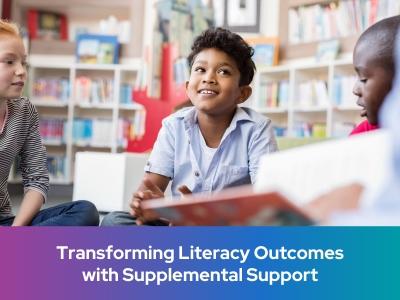
District leaders agree: supplemental programs change literacy outcomes. In our on demand edWeb session on Strategic Literacy Innovation: Transforming Literacy Outcomes with Supplemental Support, moderated by Dr. Donna Wright, education leaders discussed the impact of pairing core curricula with targeted solutions. The panel included:
- Dr. Judith J. White
- Dr. Anna Stubblefield
- Kelly Johnson
- Cari Stanley
Their insights provide real-world perspectives on why supplemental programs are essential for closing gaps, supporting teachers, and driving measurable results.
Core curricula often emphasize comprehension and writing but may not provide sufficient focus on phonics, decoding, and other foundational skills. Supplemental solutions strengthen these areas, so every student develops a solid reading base.
Kelly Johnson, Superintendent of Clinton City Schools, shared that her district’s core curriculum “did not place an emphasis on foundational reading skills, and that left us having to look for supplemental materials that were going to help us close that gap.”
The right supplemental solution ensures all students receive the instruction they need to become confident, capable readers.
Students across multiple grade levels often need focused instruction in foundational skills. Supplemental programs offer structured, research-based interventions that effectively support Tier I, II, and III students. Kelly Johnson said her district saw “a heavy emphasis on comprehension, a lot of the writing pieces but very much lacking in … the foundational literacy instruction. We felt that strain which is why we went searching for additional supplemental materials.”
By directly addressing gaps, supplemental instruction ensures that students receive the precise support they need.
Structured supplemental programs follow a systematic, explicit approach that leads to measurable gains. Cari Stanley noted that her district previously tried to piece supplemental materials into their current curriculum but didn’t find that approach successful. When Etiwanda School district adopted Really Great Reading products, they established a dedicated block of time aligned with the program's specific scope and sequence to effectively integrate the new supplemental materials. In Etiwanda School District’s first year of implementation, some school sites have reached 80-90% grade-level proficiency in their mid-year assessments.
A well-structured supplemental program supports educators in delivering targeted instruction while allowing flexibility to meet student needs.
State-approved programs can still leave major gaps in literacy instruction. Districts often discover these weaknesses after analyzing student performance data. Kelly Johnson stated, “the false assumption [is] that if the state had vetted [core literacy programs], it was meeting the needs of kids. We bought into that, and it took a while for us to scratch our heads and say, ‘The data is not showing that this is getting the job done.” Trusting only state-approved curricula can leave educators at all levels scrambling to address deficiencies. Venturing beyond these programs to proven evidence-based supplemental resources creates a more well-rounded literacy strategy.
Explore proven, Science of Reading–aligned programs that help secondary students build decoding skills, strengthen comprehension, and close gaps quickly.
Teachers often need more resources to deliver explicit, systematic instruction effectively. Supplemental programs offer professional development, lesson modeling, and teacher-led routines that simplify implementation.
Dr. Judith White of Prince George’s County Public Schools explained, “As we were rolling out the Science of Reading, we noticed that our teachers struggled with explicit instruction, so we had to find a supplemental resource.” By leveraging Really Great Reading’s structured literacy strategies, teachers can bridge instructional gaps and improve student outcomes.
Unlike fragmented approaches, supplemental solutions follow a clear scope and sequence that builds skills logically and prevents stagnation. Students strengthen previously learned concepts while steadily moving toward more complex texts.
Really Great Reading provides teachers with eLearning, webinars, on-demand videos, and in-person training. These resources can be revisited anytime, helping teachers strengthen their practice long after initial training.
Dr. White highlighted, “If you were using that curriculum you had videos you could go back and watch over and over again, not just a sit and get once.”
Many students plateau in third grade and struggle with multisyllabic words and complex texts in later grades. Supplemental programs provide structured practice that prevents stagnation and supports literacy growth through secondary school.
Districts transitioning to Science of Reading-aligned instruction find supplemental programs essential. These programs provide the structured, explicit teaching needed to ensure fidelity to the research while filling instructional gaps.
Dr. White shared that the combination of explicit supplemental support and professional development helped Prince George’s County raise their literacy assessment scores.
Core programs often force teachers to create or adapt foundational skills lessons on their own. Supplemental solutions provide ready-to-use, evidence-based resources that save time while ensuring consistency.
Dr. Anna Stubblefield emphasized that fidelity and adequate instructional time are key to making supplemental programs effective. When implemented well, these resources reduce workload while increasing impact.
Join our Structured Literacy Instruction community and download Overcoming Literacy Challenges with Really Great Reading to discover how RGR solutions can reduce teacher workload while maximizing student impact.
National Center for Education Statistics. (2024). The Nation’s Report Card: 2024 Reading Assessment (Grade 4 and Grade 8). U.S. Department of Education, Institute of Education Sciences. https://www.nationsreportcard.gov/reports/reading/2024/g4_8
National Center for Education Statistics. (2025). The Nation’s Report Card: 2024 Reading Assessment (Grade 12). U.S. Department of Education, Institute of Education Sciences. https://www.nationsreportcard.gov