
Proven Reading Interventions for California’s Learners
California districts’ commitment to Science of Reading–aligned literacy instruction demands a clear path from identification to intervention.
Really Great Reading helps schools deliver consistent, targeted instruction—building confident teachers, stronger readers, and measurable literacy growth across Tier 2, Tier 3, special education, and tutoring programs.
RGR equips California educators with explicit, paper-based routines that actively engage students. Whether supporting Multilingual Learners or closing foundational gaps in secondary schools, we provide the practical tools to make your intervention blocks actually work.
Structured literacy instruction aligned with California's Screening for Risk of Reading Difficulties serves as the immediate, evidence-based next step for students identified as at-risk, helping districts translate screening data into targeted instruction.
Targeted Tier 2 and Tier 3 intervention for striving readers in grades 3-8, with age-appropriate materials designed to build strong reading foundations, address skill gaps, and provide the explicit instruction students need to become stronger readers.
Easy-to-implement routines that support the CA ELA/ELD Framework, providing the explicit decoding, fluency, and vocabulary instruction MLLs need to access grade-level text while honoring students’ linguistic assets and supporting language development.
RGR's interventions for older students, HD Word and Orbit, support different parts of literacy development, working together to help students move from accurate word reading to comprehension. HD Word builds advanced decoding skills, while Orbit reinforces multisyllabic word fluency and builds the morphology, vocabulary, and language comprehension skills that help students unlock meaning from complex text.
Access the Scope & Sequence documents to see how RGR's instruction progresses from decoding multisyllabic words to building vocabulary, language comprehension, and meaning.
California districts are doing the hard work of adopting state-approved core curricula and advancing Science of Reading–aligned literacy instruction, but Tier 1 alone cannot close every foundational reading gap. When core programs fall short for Multilingual Learners or older striving readers, schools need specialized, high-impact intervention. Fortunately, California districts have the purchasing autonomy to implement proven Tier 2, Tier 3, and tutoring solutions that deliver actual classroom-level results.
Real reading breakthroughs happen through active instruction—not by leaving students to learn at their own pace in front of a screen. We combine high-quality print with intentional digital tools designed to empower the teacher, driving engaging, multi-modal lessons that build automaticity faster.
Implementing Science of Reading–aligned instruction requires more than adopting a curriculum. Educators are working across mixed instructional models and need clear, practical instructional routines and job-embedded coaching to confidently deliver interventions every day.
California districts have the flexibility to choose intervention solutions that deliver measurable impact, and RGR provides the instructional outcomes and student growth data districts need to make informed decisions and sustain literacy improvement.

California teachers already have a lot on their plates and need more than just theoretical training to close severe reading gaps. They need easy-to-implement supports that seamlessly translate your district investments into daily practice.
To bridge the gap between adoption and classroom execution, RGR connects structured literacy instruction, professional learning, and ongoing implementation support to help educators confidently deliver high-impact intervention every day.
For K–5 students who need additional support, RGR provides structured, skill-focused intervention designed to close foundational reading gaps quickly. Ideal for ELOP and Title I.
For upper elementary readers, RGR provides explicit instruction in multisyllabic decoding, morphology, fluency, vocabulary, and comprehension to bridge decoding and complex text.
For middle school students with foundational gaps, RGR offers structured, age-appropriate decoding and comprehension support. Perfect for secondary MTSS.
California districts serve a large, diverse multilingual learner population. Built on the Science of Reading, RGR's structured literacy programs provide the explicit phonics, decoding, vocabulary, and comprehension instruction that multilingual learners need to access grade-level text. Our routines work alongside existing language development programming to accelerate English literacy, support implementation of the California ELA/ELD Framework, and advance California's broader goals for multilingualism and biliteracy.
Sunburst Academy accelerated literacy gains for secondary students with interrupted learning by embedding structured literacy instruction into daily intervention, improving decoding, fluency, and academic confidence.
The challenge: Many students entered the school year significantly below grade level after years of limited intervention success, resulting in low confidence and reluctance to participate.
The approach: Sunburst Academy embedded RGR's explicit, multisensory structured literacy routines into daily intervention, equipping educators with progress monitoring and targeted small-group lessons.
The result: 100% of students demonstrated measurable decoding growth, reading fluency grew by 71%, and students achieved an average 40% increase in decoding performance.
RGR's literacy solutions are built on decades of Science of Reading research and validated through independent third-party research, with all-green EdReports ratings and ESSA evidence alignment. In California, RGR partners with districts, County Offices of Education, and SELPAs on implementation that aligns to state literacy expectations and risk of reading difficulties screening mandates.
If you’d like to explore how RGR can support your students, we’d be glad to connect.
“These students are not only learning to read; they're learning to believe in themselves again.”
California's literacy work runs through districts, County Offices of Education, and regional partnerships. RGR is built to work inside that structure.
Intervention and professional learning that help districts improve literacy outcomes and build long-term instructional capacity. Align funding, including Title I and ELOP, with proven interventions that deliver measurable student growth and ROI.
Science of Reading–aligned, structured literacy routines for students receiving special education services and multilingual learners at every grade level, with materials and supports that respect both populations and support the California ELA/ELD Framework.
A partnership built for California's regional structure. RGR coordinates with County Offices on shared professional development, intervention adoption, and implementation support to help districts build instructional capacity and support successful district-wide implementation.

Roberta supports districts across the state. She’ll help you navigate California's unique funding landscapes, align with California's Screening for Risk of Reading Difficulties requirements, and set up low-risk pilots to prove student growth before you scale.
See how Sunburst Youth Challenge Academy achieved 100% decoding growth and helped 71% of their adolescent students show measurable growth in reading fluency, giving them the skills and confidence to succeed.

An overview of how RGR’s easy-to-implement programs can power your Expanded Learning Opportunities Program (ELOP), providing high-impact, evidence-based literacy instruction for before-school, after-school, and summer learning.
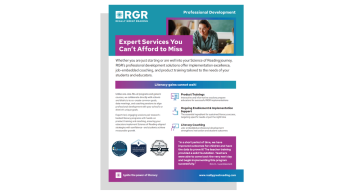
An overview of our structured PD offerings for California educators, designed to strengthen literacy instruction, support implementation fidelity, and build long-term instructional capacity across classrooms and schools.
How does RGR align with California's Screening for Risk of Reading Difficulties requirements?
RGR's structured literacy approach is built on evidence-based research required to support at-risk students. Once California students are screened, RGR provides the immediate, explicit phonemic awareness, phonics, and decoding instruction needed to intervene effectively.
How does RGR work alongside our state-adopted core literacy program?
RGR is designed to supplement core programs, not replace them. California districts use RGR to provide Tier 2 and Tier 3 intervention for students whose foundational reading gaps aren't fully closed by core instruction, to support multilingual learners, and to deliver age-appropriate adolescent intervention. Because RGR is an intervention and tutoring solution, districts have full purchasing autonomy.
Can RGR support our multilingual learners?
Yes. RGR supports multilingual learners through structured, explicit literacy instruction that helps students access grade-level reading, fully complementing the CA ELA/ELD Framework. RGR includes embedded multilingual supports such as native-language scaffolds, articulation videos, and visual resources that make foundational skills more accessible.
How can we fund RGR implementations in California?
California districts successfully utilize a variety of funding sources for RGR, including Expanded Learning Opportunities Program (ELOP) funds for after-school tutoring, Local Control and Accountability Plan (LCAP) funds, Title I, and Transitional Kindergarten (TK) grants.