
Reading Intervention for Grades 3–8
Know what’s blocking each reader. Deliver instruction that changes it.
Two students can post the same reading score and need opposite instruction. One cannot read the words. One reads them and does not know what they mean. Place both in the same intervention block and you lose a year for one of them.
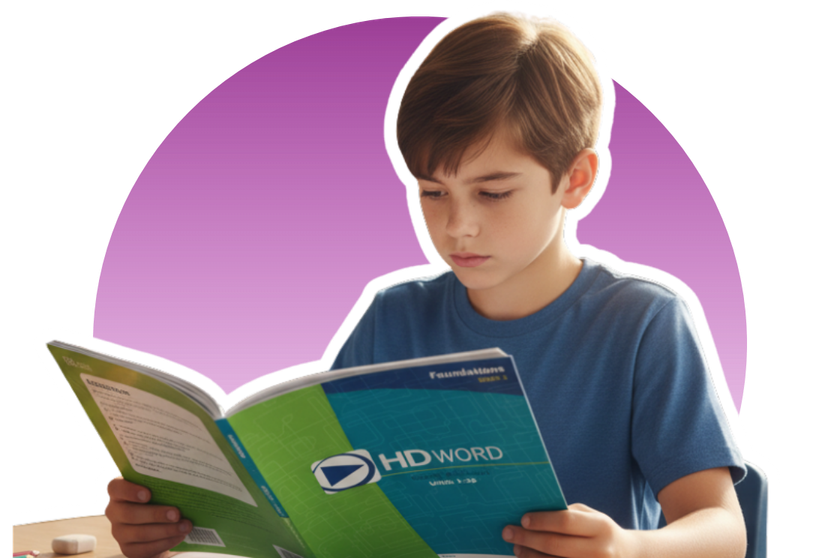
One intervention block a day. One hundred eighty days. A misplaced student loses all of them.
Gaps that are addressable in grades 3–8 become harder and more expensive to remediate every year they persist.
Placement takes twenty minutes. Get it right before the block starts.

Word recognition and decoding gap.
“They still can’t read the words.”
Avoids reading aloud. Reads slowly. Guesses at longer words. Breaks down on multisyllabic words. Weak spelling and fluency scores.
Language comprehension gap.
“They can read it, but they don’t understand it.”
Reads accurately. Cannot summarize or explain. Struggles with academic vocabulary. Falls apart in science and social studies before ELA.
→ Most intervention rosters in grades 3–8 contain both profiles. Most intervention programs address only one.
The pathway is chosen by what the data shows, not by what grade the student is in. Both pathways are built for grades 3–8.
If students...
Cannot read unfamiliar single- and multisyllabic words accurately
Pathway: HD Word
If students...
Decode accurately but struggle with word meaning and comprehension
Pathway: Orbit
If students...
Show gaps spanning both foundational decoding and language comprehension
Pathway: HD Word + Orbit
Pathways to Proficiency gives K–12 leaders a placement framework that's evidence-aligned, easy to apply at scale, and built to hold up when you have to explain it to your school board.
RGR’s intervention framework delivers explicit instruction in advanced decoding, vocabulary, and language comprehension. Districts deploy the exact pathway or combination required based on what screening and diagnostic data reveal about each student.
For students with both decoding and language gaps
A comprehensive, dual-targeted approach that pairs advanced phonics, word recognition, and multisyllabic decoding with explicit morphology, vocabulary, and language comprehension instruction to address complex learning needs.
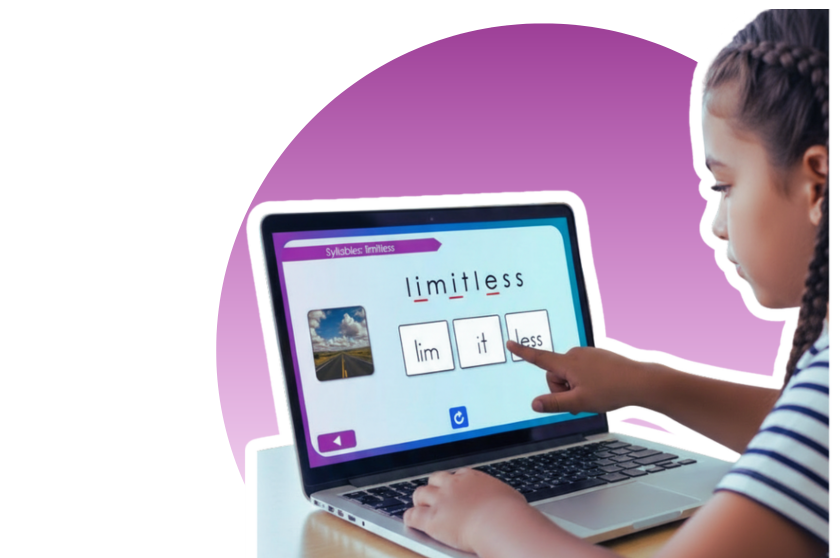
Educator resources:
Teacher’s guides. School-year access to the online teacher presentation tool. Assessments and progress-monitoring tools. School-year access to the digital Professional Development Library.
Student resources:
Student workbook sets. Decodable books and decodable passages. Manipulative kits. School-year access to digital practice. Multilingual digital and printable resources in eight languages.
Live onsite training. Live virtual training. Job-embedded coaching with observation, lesson modeling, and data-informed feedback. An on-demand digital PD Library with short modules educators can access all year.
Fits the block you already have.
30 minutes
Targeted skill work, small group
60 minutes
Full intervention block: daily lesson, practice, progress monitoring
90 minutes
Intensive support: combined pathways, extended practice.
Launch anytime during the school year. No master schedule rebuild. No prior Science of Reading background required to teach the lessons.

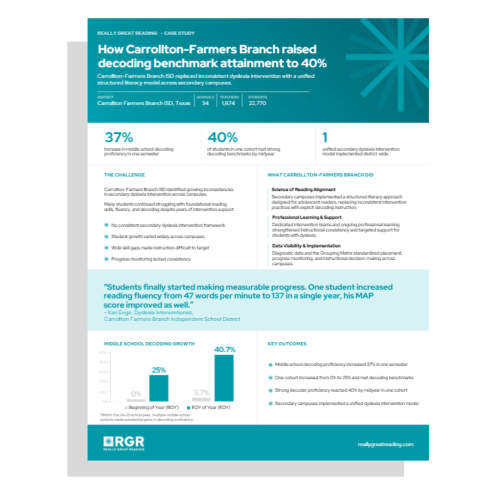
Carrollton-Farmers Branch ISD — 37-point gain in middle school decoding proficiency in a single semester among students receiving dyslexia services.
The challenge: Inconsistent secondary dyslexia practices and limited alignment for older learners across campuses.
The approach: RGR's Reading Intervention for Grades 6-12, with standardized placement and progress monitoring across all secondary campuses.
The result: One middle school cohort grew from 3.7% to 40.7% strong decoders in a single year.
Boost, RGR’s intensive intervention for grades 4–12, offers mature, slower-paced instruction for readers who need substantial support, students in special education, and learners with dyslexia. Boost is a separate program, not part of the Grades 3–8 solution.
Screening flags the gap. This guide secures the funding your district can defend.
This Intervention Funding Guide gives K–12 leaders a clear financial framework that is evidence-aligned, easy to apply at scale, and built to hold up when you present your budget to your school board.
Access the funding strategy behind high-impact literacy interventions.

RGR’s programs consistently meet the highest standards for literacy instruction:
- Vocabulary acquisition: In a peer-reviewed 2022 study of 5th-grade students, learners using the semantic reasoning approach used in RGR products acquired academic vocabulary three to four times faster than students in direct-instruction comparison groups. Kennedy et al., Journal of Special Education Technology.
- EdReports awarded RGR all green, near-perfect scores for alignment, usability, and instructional quality
- ESSA Tier II studies show RGR programs accelerate student progress across classrooms
- The Reading League's review found no “red flags” across the skills RGR's programs target
- Rivet Education certifies RGR in the Professional Learning Partner Guide for high-quality educator PD
Districts that place students correctly before the first intervention block get a full year of instruction. Districts that place in September and correct in January get half.
Meet with a Literacy Specialist to review your screening data, identify which readers need decoding support and which need language support, and build a placement plan for your grades 3–8 intervention block.

What grades is the program appropriate for?
RGR’s adolescent literacy intervention was developed to address the phonics, vocabulary, and comprehension deficits of adolescent learners in grades 6-12.
Phonics and decoding skills are essential prerequisites for strong reading comprehension because they enable students to accurately and automatically recognize words, freeing up cognitive resources to focus on understanding the meaning of the text. Without these foundational skills, students struggle to decode unfamiliar words, which disrupts the flow of reading and impedes comprehension. Research shows that deficits in phonics and decoding prohibit progress not only in ELA but also across subject areas, since reading is integral to learning in all content areas. For example, difficulties in decoding can hinder students’ ability to access content in science, social studies, and mathematics, where subject-specific vocabulary and complex texts are common. Therefore, strong phonics, decoding, and vocabulary skills are critical for academic success across the secondary curriculum.
What components are included in the program?
RGR’s reading intervention for middle school includes:
- HD Word: A systematic, explicit, multi-sensory decoding intervention, teaching phonics to older students
- InferCabulary: A visual vocabulary program that accelerates vocabulary acquisition and comprehension
- Decodable Chapter Books: Age-appropriate, mature decodable texts aligned with HD Word’s scope and sequence
- HD Word Skills Assessments: Tools for progress monitoring and identifying student needs
- Educator Training: In-person or virtual training designed for teachers of adolescent struggling readers, even those without prior Science of Reading experience
What makes Really Great Reading’s decodable texts different from others on the market?
Unlike many decodable books that feel babyish, are oriented for elementary students, or are retrofitted for older students, RGR’s Hidden Gems decodables are mature, aesthetically appropriate, and culturally diverse. These efficient reading tools for struggling readers are specifically aligned with HD Word, making it easy for teachers to reinforce targeted phonics patterns and help students transfer these skills to more complex academic reading.
How does RGR’s Reading Intervention for Grades 6-8 differ from interventions for younger students?
Unlike early elementary interventions, this program uses age-appropriate decodable chapter books and materials tailored to older students, respecting their interests and maturity, ensuring that content is both accessible and engaging for adolescents while still focusing on essential reading skills. This approach ensures that adolescents receive explicit, systematic phonics and decoding instruction validated by decades of research in the Science of Reading, in a format that is relevant, motivating, and accessible for their developmental stage. In short, the result is a program that not only builds essential reading skills but also fosters confidence and engagement in older readers, making RGR’s Reading Intervention for Grades 6-12 one of the best reading interventions for middle and high school students.
How does the program teach vocabulary and deepen word understanding?
Vocabulary instruction is a central component of the intervention. HD Word lessons introduce Tier 2 academic vocabulary using InferCabulary, which presents words in multiple contexts with images and captions. This approach helps students understand nuanced and figurative meanings, teaches semantically related words, and encourages connections between words and concepts. Multi-contextual vocabulary practice ensures students develop a robust and flexible understanding of new words.
What makes Really Great Reading’s Reading Intervention for Grades 6–12 different from other literacy interventions?
Our program is specifically designed for adolescent learners, addressing the unique challenges older students face with reading. While the foundational principles—like decoding and phonics—are rooted in the science of reading and remain consistent across all ages, this program uses age-appropriate, engaging materials such as decodable chapter books with interesting, adolescent-friendly themes and sophisticated storytelling. The curriculum goes beyond basic decoding to include direct instruction in vocabulary, inferencing, summarization, sentence structure, and academic language, ensuring students not only read words but develop the needed strategies to tackle complex texts.
Is Boost part of the Reading Intervention for Grades 6-8 bundle?
No, Boost is a separate Tier III intervention for students who need a slower pace due to significant learning disabilities. While not included in the standard Reading Intervention for Grades 6-12, schools may choose to add Boost based on student assessment outcomes.
What is the recommended time of daily instruction?
We recommend 60 minutes of daily instruction:
- Direct instruction: 20 minutes
- Practice to Mastery: 10 minutes
- Vocabulary practice: 15 minutes
- Decodable chapter books: 10 minutes
- Assessment: 5-10 minutes weekly
However, we know that the needs of each student, classroom, school, and district are unique, so our literacy partners work directly with your team to ensure a successful, flexible, and impactful implementation of the solution, no matter the frequency or length of your intervention sessions.
Where can I find a sample of the lessons that accompany the decodables?
Here’s a downloadable sample lesson
Can any teacher implement the intervention, or is specialized training required?
Any educator can implement this Intervention. The program is designed to be teacher-friendly, with scripted lessons, built-in tools, and minimal prep time required. Training is included to help educators, regardless of their background in literacy instruction, successfully deliver the intervention while improving their understanding and implementation of the Science of Reading.
Is the program RTI-based?
Yes, the Reading Intervention for Grades 6-12 is RTI-based and supports a tiered intervention structure. The phonics and decoding components of the program, HD Word, were designed to be flexibly implemented across RTI tiers, ranging from Tier 1/whole-class instruction to Tiers 2 and 3 for students who are starting to fall behind and learners with specific or mild decoding weaknesses respectively.
Additionally, the placement into the intervention is driven by diagnostic assessments, including the Beginning and Advanced Decoding Surveys, Oral Reading Fluency assessments (ORF), and the Grouping Matrix, a practice consistent with RTI models. Frequent formative assessments also support the RTI cycle of screening, instruction, and monitoring.
The program is intensively focused on foundational skills, including phonemic awareness, decoding, and vocabulary, making it a strong RTI-aligned option for students requiring support in these areas.
Does the program support implementation within a Multi-Tiered System of Supports (MTSS)?
Yes, our adolescent literacy intervention supports implementation within a Multi-Tiered System of Supports (MTSS). Here’s how the program provides a full continuum of support, allowing educators to respond to student needs within the MTSS framework:
- Universal Screening and Targeted Supports: The program offers comprehensive diagnostic tools (e.g., decoding surveys, vocabulary assessments) and provides structured supports across all three tiers of MTSS.
- Tiered Instructional Options: It can be flexibly implemented across Tiers 1, 2, and 3
- Additional Tools and Structures: Scaffolded instruction routines (e.g., “I Do, We Do, You Do”), built-in formative assessment, differentiated practice opportunities through both digital and print-based materials, multisensory instruction for diverse learners
How does the program strengthen comprehension skills?
The Reading Intervention for Grades 6–12 combines foundational decoding instruction as well as development of comprehension strategies and higher-level language, in a program designed to accelerate reading growth for adolescents. The program reflects and applies the recommendations and findings from relevant research literature on reading comprehension, offering an integrated and evidence-based path to build higher-level language skills.
Here are some of the strategies and resources for teaching reading comprehension the program employs:
- Purposeful re-reading in the Hidden Gems decodables provides mature students with intentional opportunities to practice skills across decoding, vocabulary, comprehension, and expression, leading to improved fluency—accuracy, automaticity, and prosody—and deeper comprehension.
- In parallel, focused grammar and syntax work helps students understand how sentence structure creates meaning, supporting both reading and writing skills. Frontloading words with semantic reasoning helps get students ready to use and understand them deeply, while vocabulary and morphology are taught through visuals and repeated encounters in connected text, making instruction functional and connected to comprehension.
Have RGR’s programs been evaluated for their efficacy by external examiners or third parties?
Yes! RGR programs are ESSA-validated and grounded in the Science of Reading. Our foundational literacy programs meet ESSA’s rigorous Tier II criteria and have received all green, near-perfect scores on independent reviews from EdReports.
The Reading League, a trusted authority in the Science of Reading literacy instruction, has also thoroughly evaluated our programs and found no "red flags" in the areas our programs are designed to address: Word Recognition, Phonological and Phoneme Awareness, Phonics and Phonic Decoding, Fluency, Handwriting, and Spelling.
These external validations highlight the effectiveness of RGR’s literacy programs in building strong, capable readers. Our tools are designed to meet high standards and deliver real results.
Learn more about our product efficacy!
Does the program prepare students for post-secondary pathways and career-related literacy tasks?
Yes! The Reading Intervention for Grades 6-12 is designed for students who read below grade level and those who are at risk of not meeting College- and Career-Ready Standards (CCRS) and supports CTE-readiness outcomes.
With a focus on foundational gaps, this intervention directly addresses decoding, fluency, and vocabulary gaps that hinder access to complex grade-level texts—critical for CCRS alignment. The integrated vocabulary solution systematically builds Tier 2 vocabulary using semantic reasoning, visual supports, and contextual examples, which are also emphasized in CCRS. Additionally, the intervention cultivates transferable literacy skills, morphological analysis for understanding domain-specific terminology, oral reading and comprehension skills to support access to CTE and core content areas.
To achieve academic success, adolescents must be able to read and comprehend content across a variety of subject areas, skills that are fundamental for both present and future learning. RGR’s intervention equips learners with the skills required for success in high school coursework, career pathways, and post-secondary education, enabling students to fully engage with complex texts in every discipline, setting them on a path toward lasting achievement.
What is the cost of the Reading Intervention for Grades 6-8?
For detailed pricing information, including bundle options and licensing, please contact our team at [email protected] or 866-401-7323, or request a quote.
Is there a free trial available for the program?
Free trials are available for: