
Really Great Reading Evidence Center
See the independent reviews, ESSA ratings, district case studies, and outcomes based contracting work behind Really Great Reading’s programs. That instruction is the foundation of RGR Nova™, the Literacy Outcomes System (LitOS™), which has its own ESSA Level IV logic model and a higher-level study in design.

Since 2025, RGR students have mastered 15.6 million foundational reading skills — 4.2 million of those in the last quarter alone.
Partnering with educators and leaders across diverse school systems.
Helping educators turn reading science into practical instruction.
What independent reviewers have found
ESSA Level IV: RGR Nova
The RGR Nova logic model for intervention, Grades 3–12, meets ESSA Level IV, Demonstrates a Rationale, validated by Instructure.
ESSA Level IV: Foundational skills programs
Countdown, Blast, and HD Word, RGR’s Grades K–2 programs, are supported by an ESSA Level IV logic model.
ESSA Level III Validation
Really Great Reading programs meet ESSA Level III (Promising Evidence) standards. Independent correlative studies conducted by LearnPlatform by Instructure found that increased use of RGR instruction was significantly associated with higher reading achievement for students in Kindergarten and Grades 2–5.
Read the Reports: New York | Washington

ESSA Level II Validation
Really Great Reading’s Literacy Suite holds ESSA Level II certification. Independent quasi-experimental studies conducted by LearnPlatform found higher adjusted reading scores for Kindergarten and Grade 1 students using RGR than for matched comparison students.
Read the Reports: Urban Charters | Kindergarten

Evidence for ESSA “Promising” Level
RGR programs are rated “Promising” by Evidence for ESSA at Johns Hopkins University.

EdReports: “All Green” Scores
RGR’s K–2 foundational skills programs received “all green” ratings for alignment, usability, and instructional quality (2023).

Recognized as a High-Quality Professional Learning Partner
Really Great Reading is a certified provider in Rivet Education’s Professional Learning Partner Guide.

The Reading League Evaluation
The Reading League’s Compass evaluation found RGR meets criteria for structured literacy programs, with no red flags identified.
District teams across the country are using RGR programs and measuring the results. These case studies describe what they did and what changed for their students.




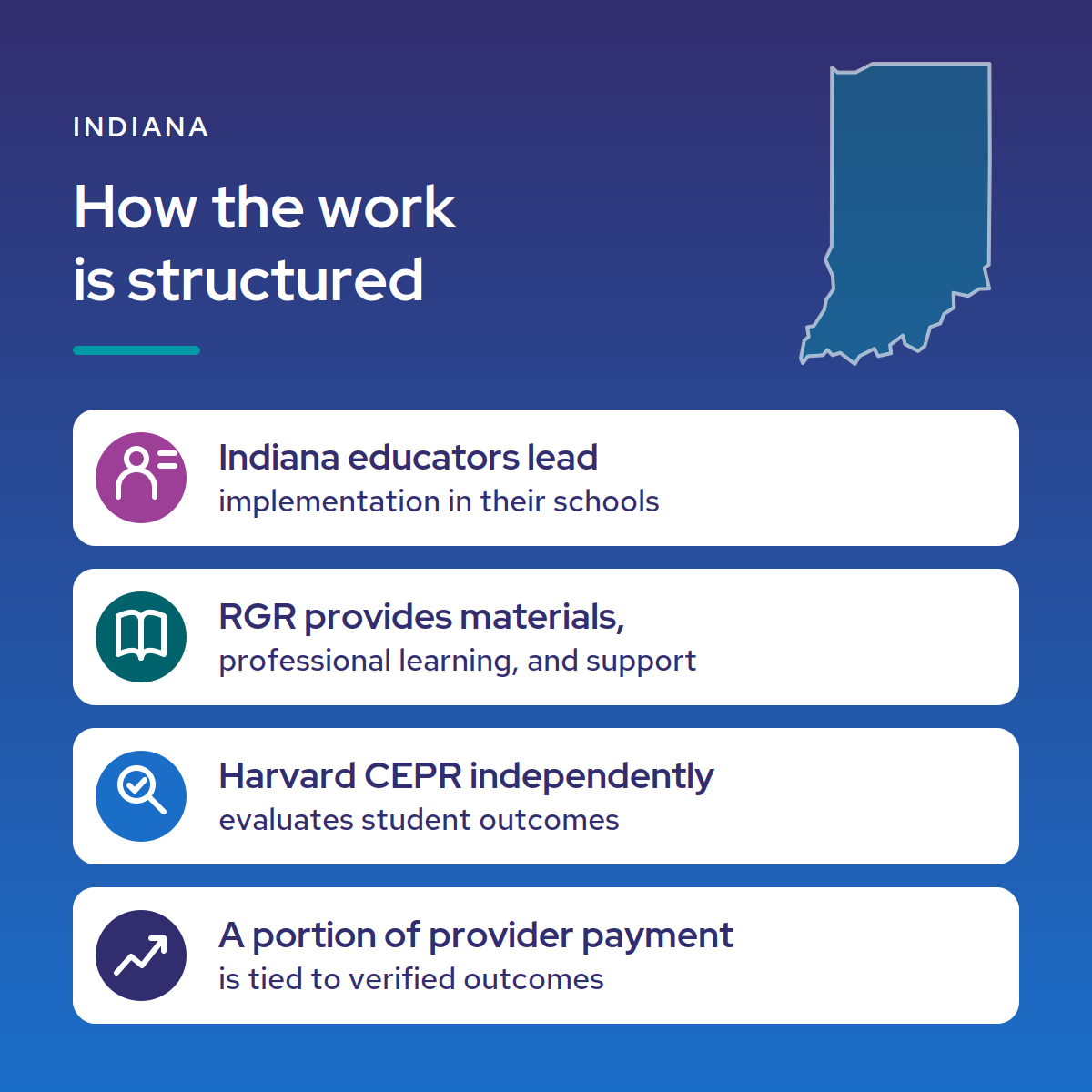
The Center for Education Policy Research (CEPR) at Harvard University is independently evaluating student outcomes from an Indiana Department of Education initiative with RGR and two other providers. The work is structured through outcomes based contracts (OBCs), with a portion of provider payment tied to verified student outcomes.
Indiana educators lead implementation in their schools. RGR provides high-quality instructional materials, professional learning, and implementation support, and shares responsibility for the outcomes the partnership set out to achieve together.
How RGR Nova™ is designed to improve literacy outcomes
The RGR Nova™ logic model shows how the system connects to outcomes a district can measure. Instructure’s research team validated the logic model for intervention, Grades 3–12, as meeting ESSA Level IV, Demonstrates a Rationale.
Inputs
Assessment, instruction, and educator support, plus protected time
Participants
Readers in Grades 3–12 and their educators
Activities
Screen, group, teach, adjust
Outputs
Placement, mastery, and fidelity data
Outcomes
Measurable, lasting literacy growth
Research-grounded infrastructure from our partners
RGR Nova is built with partners whose tools rest on their own research and validation.

MetaMetrics and the Lexile® Framework
The Lexile® Framework for Reading places readers and texts on the same scale. RGR Nova uses trusted Lexile measures to measure reading ability, monitor growth over time, and connect students with appropriately challenging materials and instruction.

Learning Commons Knowledge Graph
RGR selected the Learning Commons Knowledge Graph to help power the skills intelligence behind RGR Nova. Its structured learning components and progressions help map how literacy skills relate and build over time.
District leaders deserve to know what’s working for their students, and so do we. RGR is designing an ESSA Level III or higher study of RGR Nova™, and we’ll share what we learn on this page.
Independent evaluation
We work with third-party researchers to study RGR programs and RGR Nova™.
Clear reporting
We describe each study’s design, sample, and limitations alongside its findings.
Evidence matched to grade band
We cite each study only for the grades and uses it examined.
Regular updates
We update this page as studies begin and results become available.
See RGR Nova™ for your district
Request a private first look, and we’ll walk your team through RGR Nova™ and the evidence behind it. Or explore RGR Nova™.
What is RGR Nova™?
RGR Nova™, the Literacy Outcomes System (LitOS™), brings curriculum, assessment, professional learning, and data together around one goal: better literacy outcomes.
What ESSA evidence level does RGR Nova™ have?
The RGR Nova™ logic model for intervention in Grades 3–12 meets ESSA Level IV (Demonstrates a Rationale). Instructure's research team validated it in October 2026 after reviewing the logic model, the 15 studies that inform its design, and RGR's plan for an ESSA Level III or higher study. RGR's Grades K–2 programs have their own ESSA Level IV logic model and ESSA Level II evidence.
Is RGR Nova™ being independently studied?
RGR is designing a study of RGR Nova™ built to meet ESSA Level III or higher. Separately, the Center for Education Policy Research at Harvard University is evaluating results from Indiana's outcomes based contracts with RGR and other providers, which use RGR's current programs.
What is an outcomes based contract (OBC)?
An outcomes based contract is an agreement in which part of a provider's payment depends on verified student outcomes. Districts can choose an OBC or an all-in pricing model with RGR. Under either, RGR shares responsibility for the outcomes the partners set out to achieve together.
What research is RGR Nova™ built on?
RGR Nova™ draws on Science of Reading research in word reading, morphology, fluency, language comprehension, and writing, along with research on professional learning for teachers of older readers. It also uses research-grounded infrastructure from partners including MetaMetrics and Learning Commons.
Is RGR Nova™ the same as LitOS™?
Yes. RGR Nova™ is the name for the Literacy Outcomes System RGR previously announced as LitOS™.
Why do literacy outcomes vary across districts?
Implementation quality, professional learning, instructional consistency, and intervention support all affect outcomes.