
From Decoding to Meaning Making
Why reading develops as a continuum, not a handoff
In early reading instruction, decoding is often treated as the primary milestone. Students learn to map sounds to letters, recognize words, and build accuracy and fluency. These skills are essential, and for many students, they represent significant progress.
However, reading does not end with accurate word recognition. As texts become more complex, students are expected to do more than identify words. They must interpret meaning, connect ideas, and understand how language works across sentences and paragraphs.
This shift is not a transition from one skill to another. It is the development of a system in which word recognition and language comprehension work together to support understanding.
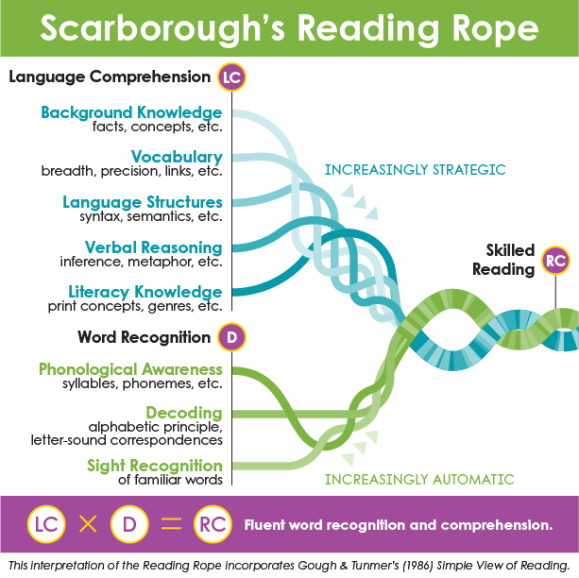
Reading development is often described as a shift from “learning to read” to “reading to learn.” While this framing is widely used, it can be misleading because reading is not a handoff between decoding and comprehension. It is a continuous process in which both develop together over time.
This integrated view of reading development is reflected in Scarborough’s Reading Rope, which illustrates how skilled reading emerges from the interaction of two strands: word recognition and language comprehension. These strands develop alongside one another and become increasingly interconnected as students grow.
Word recognition includes phonological awareness, decoding, and automatic word recognition. Language comprehension includes background knowledge, vocabulary, language structure, verbal reasoning, literacy knowledge. Neither strand operates independently. As texts become more complex, comprehension depends on how tightly these strands are woven together.
When instruction emphasizes one strand without fully developing the other, reading becomes uneven. Students may demonstrate accuracy without understanding, or struggle to access meaning even when they can read the words.
As students become more accurate and efficient readers, the demands of text increase. Words become more complex, sentences become denser, and ideas become more abstract. At the same time, comprehension relies increasingly on a student’s ability to process language, not just recognize words.
A more accurate way to understand reading is as a continuum in which skills develop together, not in isolation. Students are not moving from one stage to another. They are building multiple processes simultaneously. Students do not stop needing decoding. They continue to encounter unfamiliar words and more complex structures. At the same time, they must rely more heavily on vocabulary knowledge, sentence-level understanding, and the ability to connect ideas across a text.
When instruction treats decoding and comprehension as separate phases, gaps begin to emerge. Students may develop strong word recognition but lack the language knowledge needed to support meaning.
Constructing meaning from text requires more than recognizing individual words. It depends on how students process language across multiple levels at once.
As students read, they must:
Interpret the meaning of individual words within context
Understand how sentences are structured and how meaning shifts across clauses
Connect ideas across sentences and paragraphs
Integrate background knowledge with what is explicitly stated
Infer meaning when information is implied rather than directly stated
These processes happen simultaneously. When one part of the system is underdeveloped, comprehension becomes less stable.
Students may be able to read a sentence accurately but misinterpret its meaning. They may understand individual sentences but struggle to connect them into a coherent idea. They may follow the surface meaning of a text but miss deeper implications.
This is not a failure of effort or engagement. It reflects the complexity of the language system required for comprehension.
Reading is not just about getting the words right. It requires connecting decoding, language, and meaning so students can fully understand what they read. This guide outlines how these elements work together to support comprehension across sentences and texts.
The foundation of this system is oral language.
Before students encounter complex written texts, they develop an understanding of how language works through listening and speaking. They learn how sentences are structured, how ideas are organized, and how meaning is shaped through context.
As reading demands increase, students rely on these same capacities to make sense of written language.
Oral language supports reading by helping students:
Recognize how ideas are connected within and across sentences
Interpret meaning beyond individual words
Follow the structure of narratives and informational texts
Infer meaning based on context and prior knowledge
Monitor understanding and recognize when meaning breaks down
When students have a strong language foundation, they are better able to engage with complex text. When these foundations are limited, comprehension becomes more difficult, even when decoding is accurate.
Vocabulary is often treated as the bridge between decoding and comprehension. While it plays a critical role, it cannot carry the full weight of meaning on its own.
Knowing the definition of a word does not guarantee understanding. Students must understand how words function within sentences, how meaning shifts based on context, and how words contribute to larger ideas. For example, a student may know the definition of a word such as analyze, but still struggle to interpret how it is used within a complex sentence or applied within a broader argument.
This is why vocabulary development must be embedded within a broader language system. Words gain meaning through their relationships to other words, sentences, and ideas within a text.
As reading develops, the demands of text do not remain constant. Words become more complex, sentences become more densely structured, and ideas require greater interpretation. For comprehension to remain stable, the underlying language system must develop alongside these increasing demands. When that system does not keep pace, reading begins to outpace understanding.
In these moments, breakdowns in comprehension are not always immediately obvious. Students may continue to read accurately and appear fluent, but their ability to construct meaning becomes less consistent.
Students may:
Rely heavily on decoding without attending to meaning
Struggle to follow complex sentence structures
Lose track of ideas across a text
Misinterpret key concepts
Read accurately but without fully understanding
These patterns become more visible as texts increase in complexity. As language demands grow, students who have not developed the underlying system begin to experience greater difficulty with comprehension.
This is not a reflection of effort or ability. Rather, this reflects a mismatch between the demands of the text and the development of the language system required to support meaning.
Supporting comprehension requires a shift in how reading development is understood and addressed. Instruction must move beyond isolated skills and focus on how decoding and language work together to support meaning.
This includes:
Continuing to strengthen decoding as texts become more complex
Building vocabulary within meaningful and connected language
Developing sentence-level understanding and text structure awareness
Providing opportunities for discussion, explanation, and verbal reasoning
Supporting students in making connections and inferences across text
These elements are not separate components. They function as part of an integrated system that develops over time.
In practice, this kind of instruction is reflected in how students engage with language throughout the day.
Students are not only reading text, but also using language to build and express understanding. This can take many forms:
Discussing ideas and explaining thinking — through comprehension prompting during reading, structured partner conversations, small group or whole group discussion, and written responses that require students to explain and justify their thinking
Using vocabulary in meaningful contexts — applying new language within authentic tasks, such as using content-specific vocabulary to write a proposal, participate in a simulation, or engage in extended writing connected to a unit of study
Connecting new learning to prior knowledge — through prompts that encourage students to relate new concepts to what they already know, helping them anchor meaning and build deeper understanding
Working with increasingly complex texts — engaging with texts that include more abstract ideas and more complex sentence structures, with support that helps students navigate and interpret that language
These experiences help students move beyond recognizing language to actively using it to construct meaning.
Accurate word reading is a critical milestone, but it is not the endpoint of reading development. The goal is for students to construct meaning from text, which requires the coordination of multiple skills over time.
When reading is understood as a continuum, instruction shifts. The focus moves from isolated skill development to the integration of language, knowledge, and reasoning. Students are no longer learning to decode first and comprehend later. They are developing the ability to do both, increasingly well, at the same time.
Reading development is a continuum, not a transition from decoding to comprehension
Comprehension depends on the interaction between word recognition and language
Scarborough’s Reading Rope illustrates how these systems develop together
Oral language provides the foundation for interpreting written text
Vocabulary supports comprehension within a broader language system