





All Resources

All Resources

Find Your Resource

Filter by:
teacher reading to kids
Science of Reading
Orthographic Mapping Explained: Five Concepts for Literacy Success
Orthographic mapping is often discussed in literacy conversations, but what does it actually mean for classroom instruction? Explore five key concepts that help explain how orthographic mapping supports word recognition, fluent reading, and long term literacy success.
Learn More
RGR Featured in The New York Times Thumbnails
News
RGR Featured in The New York Times
The New York Times features RGR’s role in advancing structured literacy instruction and stronger reading outcomes.
Learn More
Kids laying on floor and reading books.
English Learners
The Science of Reading also Applies to Students Learning English as a Second Language
As California pushes schools to adopt research-based approaches to teaching reading, known as the “Science of Reading,” some educators and advocates for English learners worry these techniques may not be effective for students learning English as a second language.
Learn More
Structured literacy illustration
Science of Reading
What is Structured Literacy?
Structured Literacy is an explicit, systematic approach to reading instruction that helps students develop the foundational skills necessary for literacy success. Grounded in the Science of Reading, Structured Literacy provides a framework for teaching reading, spelling, and writing in a way that supports all learners, including students with dyslexia.
Learn More
older kids outside
Science of Reading
How Orthographic Mapping Builds Sight Word Recognition
Many educators struggle with how to teach tricky sight words that do not follow expected spelling patterns. Fortunately, students do not need to rely on memorization alone. By using orthographic mapping and Heart Word strategies, educators can help students store high-frequency words in memory for automatic recognition and spelling.
Learn More
Phonological awareness illustration
Foundational
Phonological Awareness vs. Phonemic Awareness: What's the Difference?
Phonological awareness and phonemic awareness are closely related foundational literacy skills, but they are not the same thing. Understanding the difference can help educators provide more effective instruction and support early reading development.
Learn More
Phonemic awareness illustration
Science of Reading
Six Layers of Phonemic Awareness: Understanding How Sound Skills Develop
Phonemic awareness is more than blending and segmenting. Explore the six layers of sound awareness and how they support decoding, spelling, and reading development.
Learn More
2024 with books on the inside of the numbers
Blog post
A Look Back at 2024 Highlighting Our Big Achievements
2024 has been a transformative year for us at RGR! From impactful partnerships to exciting product launches, we’ve been working to empower educators and support learners. Here’s a look at some of the highlights that have shaped our year.
Learn More
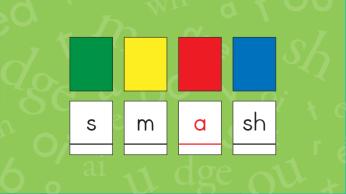
Sample flash cards or the work smash.
Science of Reading
What is the Science of Reading?
The Science of Reading is more than phonics alone. Explore the research behind phonics, phonemic awareness, fluency, vocabulary, oral language, and comprehension and how these components work together to support skilled reading.
Learn More
Young students attentive in classroom.
English Learners
Five Crossover Elements for English Learner Success
Language barriers should not prevent educators or other school staff from communicating and including families of English Learners (ELs). But unfortunately, it often is. At Really Great Reading we want to eliminate language as a roadblock.
Learn More
older kids presenting in front of class
Science of Reading
The Essential Building Blocks of a Modern Reading Solution
RGR's essential building blocks of a Modern Reading Solution
Learn More
Three kids sitting in a reading circle.
English Learners
What Makes RGR's Multilingual Supply Room Unique?
The Multilingual Supply Room is the only supplemental resource that uses students’ native languages to explain English phonics skills. By providing instructional videos and materials in the student’s native language they can grasp new concepts more effectively.
Learn More
Home Connection

Really Great Reading’s Home Connection provides families with the necessary tools to reinforce the learning beyond the classroom.

Really Great Reading: Family Engagement Overview

Engaging Learning Videos

Short videos cover key topics like syllables, reading strategies, and decoding longer words.

Helpful Resources

Letter Tile Free Play, Heart Word Magic, and materials for Countdown, Blast, and HD Word align with classroom learning.
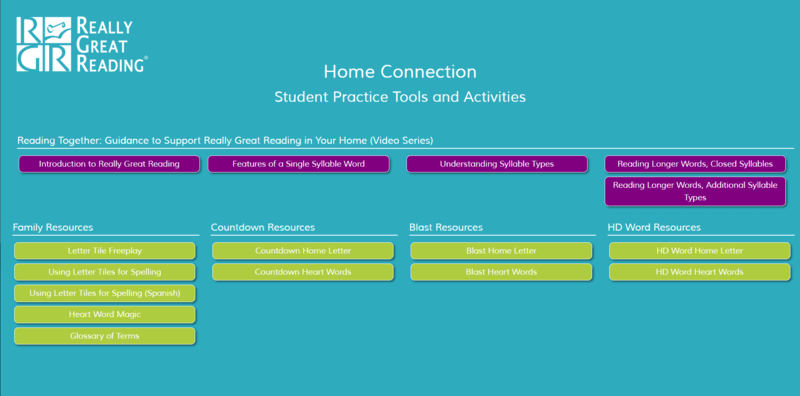
 

Home Connection start screen