
What are the Five Pillars of Reading?
Understanding the Foundation of Skilled Reading
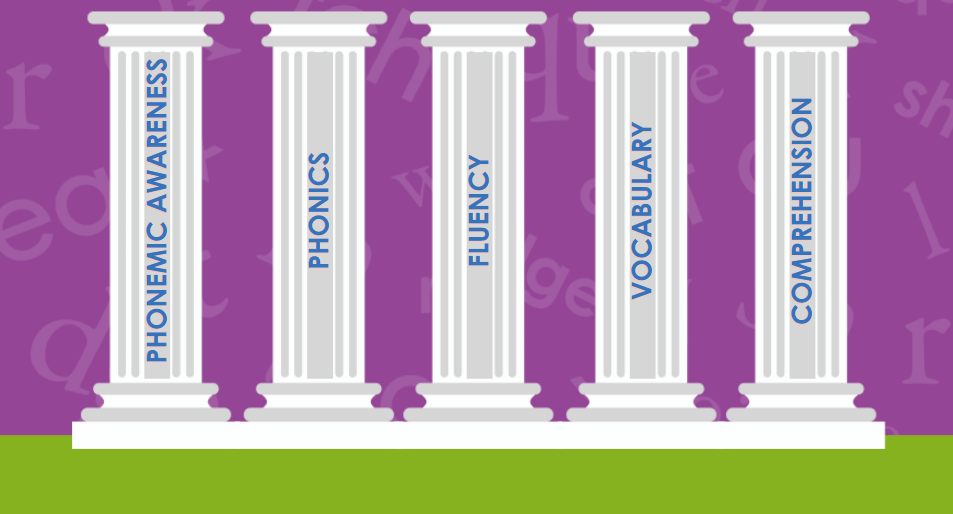
The Five Pillars of Reading are five essential components of effective literacy instruction identified through decades of reading research. These pillars include phonemic awareness, phonics, fluency, vocabulary, and comprehension. Together, they provide the instructional foundation students need to become successful readers.
Widely connected to the Science of Reading, the Five Pillars framework highlights the skills that support reading development from early foundational learning through increasingly complex reading and meaning-making. While each pillar serves a distinct role, they work together to build skilled, confident readers.
The Five Pillars of Reading provide a research-based foundation for literacy instruction. Rather than teaching reading as a single skill, the framework recognizes that students need support across multiple, interconnected areas of reading development.
Strong literacy instruction helps students develop foundational decoding skills while also strengthening vocabulary, language comprehension, and meaning-making. For educators and district leaders, understanding the Five Pillars can support instructional planning, intervention decisions, and alignment with evidence-based reading practices.
Phonemic awareness is the ability to identify, hear, and manipulate individual sounds within spoken words. Because it focuses on spoken language rather than print, phonemic awareness is considered a critical precursor to decoding and reading instruction.
Students use phonemic awareness skills to blend, segment, delete, substitute, and manipulate phonemes, supporting their ability to connect sounds to letters during reading development.
For example, a teacher might ask students to blend the sounds /m/ /a/ /p/ to form map or remove the /s/ sound from stop to create top. Activities like oral sound blending, segmenting, and phoneme substitution help students develop the sound awareness needed for later reading success.
Phonics instruction teaches students how letters and letter combinations represent sounds in written language. Through explicit phonics instruction, students learn to decode unfamiliar words, recognize spelling patterns, and build automatic word recognition.
Effective phonics instruction supports accurate reading, spelling development, and long-term literacy growth.
For example, students might learn that the letters sh represent a single sound or practice decoding words such as ship, shop, and wish to apply newly learned phonics patterns. Over time, systematic phonics instruction helps students tackle increasingly complex words with greater accuracy and confidence.
Reading fluency refers to the ability to read text accurately, automatically, and with appropriate expression. Fluency serves as an important bridge between word recognition and comprehension.
When students no longer need to devote significant cognitive effort to decoding, they can shift greater attention toward understanding and engaging with text.
For example, a fluent reader does not pause to decode every word individually. Instead, they read connected text smoothly, recognize familiar words quickly, and use phrasing and expression that reflect understanding. Practices such as repeated reading, modeled reading, and targeted decoding support can help strengthen fluency development.
Vocabulary refers to the words a student needs to recognize and understand when reading, and it is part of the complex cognitive process of acquisition.
Vocabulary knowledge supports students’ ability to understand spoken and written language. Students with stronger vocabularies are often better able to access meaning, understand academic language, and engage with increasingly complex texts.
There are three types of vocabulary words:
- Tier 1 Vocabulary Words - These are basic words that are used by most students in everyday conversation like cat, dog, chair, teacher, etc...
- Tier 2 Vocabulary Words - These are more complex contextual words that students encounter in text and that often need direct instruction like adequate, adjacent, ambiguous, and assimilate.
- Tier 3 Vocabulary Words - These are genre, subject, or domain-specific, low-frequency words. For example, in mathematics, words like numerator, quadrilateral, quartile, rhombus, and trapezoid are Tier 3 words.
Development includes oral language experiences, exposure to academic language, morphology, and meaningful opportunities to apply new language. For example, rather than simply defining the word predict, students might discuss its meaning during a read-aloud, analyze related word parts such as pre- and dict, and use the word in speaking and writing. These experiences help students build deeper, more durable word knowledge.
Reading comprehension is the process of making meaning from text. Skilled comprehension relies on multiple interacting factors, including vocabulary knowledge, background knowledge, language comprehension, decoding ability, and reasoning skills. Comprehension instruction supports students as they interpret, analyze, synthesize, and engage deeply with text. There are five types of comprehension:
- Lexical comprehension is the understanding of key vocabulary in the text.
- Literal comprehension is finding meaning as you read the text by asking questions like who, what, where, and when.
- Interpretative comprehension is inferring meaning in the text by asking what if, why, and how questions.
- Applied comprehension is relating the text to a student's existing opinion or knowledge, and then asking them to support their opinions logically.
- Affective comprehension is the ability to understand the various aspects of the plot, motive, and characters in the story.
For example, students may summarize key ideas after reading, make inferences about a character’s motivations, connect information across multiple texts, or use evidence from a passage to support their thinking. Strong comprehension instruction helps students move beyond simply reading words toward truly understanding and engaging with meaning.
The Five Pillars provide the foundation for reading success. Discover instructional approaches that support phonemic awareness, phonics, fluency, vocabulary, and comprehension.
According to The National Reading Panel, the most reliably effective approach to teaching the following five elements is by using systematic and explicit instruction.
Systematic Instruction
Skills and concepts are taught in a planned, logically progressive sequence. For example, certain sounds (those that are easier to learn or those used more often in the words students will read) are taught before other sounds. Lessons focus on clearly defined objectives and there are multiple practice opportunities to help students, master, retain, and apply their new skills. Additionally, assessments are used to progress and monitor skill acquisition.
Explicit Instruction
The teacher states clearly what is being taught and models effectively how it is used by a skilled reader. Explicit instruction ensures students clearly know objectives and expected outcomes.
The Five Pillars of Reading are closely connected to the Science of Reading because they reflect decades of interdisciplinary research on how students learn to read.
Many educators view the Five Pillars as an important instructional foundation within a broader Science of Reading ecosystem that also includes frameworks such as Scarborough’s Reading Rope, The Simple View of Reading, and structured literacy.
Understanding these connections can help educators move beyond isolated literacy skills toward more comprehensive, evidence-based instruction.
- The five pillars are phonemic awareness, phonics, fluency, vocabulary, and comprehension
- Each pillar contributes to successful reading development
- Effective instruction strengthens all five areas together
- The framework reflects decades of reading research
- The pillars support curriculum, assessment, and intervention decisions
Research Articles:
Kilpatrick, D. A. (2016). Equipped for reading success: A comprehensive, step-by-step program for developing phonemic awareness and fluent word recognition. Syracuse: Casey & Kirsch
National Reading Panel. A Closer Look at the Five Essential Components of Effective Reading Instruction: A Review of Scientifically Based Reading Research for Teachers. US Dept of Ed, 2004 Learning Point Associates, 2004
How do the Five Pillars connect to the Science of Reading?
The Five Pillars of Reading are closely connected to the Science of Reading because they reflect decades of research on how students learn to read. The framework supports evidence-based literacy instruction and aligns with broader literacy models such as Scarborough’s Reading Rope and structured literacy.
What is the difference between phonemic awareness and phonics?
Phonemic awareness focuses on spoken sounds in language and involves hearing, blending, segmenting, and manipulating phonemes. Phonics connects sounds to written letters and letter patterns, helping students decode and spell words.
Why is fluency considered one of the Five Pillars?
Fluency acts as a bridge between word recognition and comprehension. When students can read accurately, automatically, and with expression, they can devote more attention to understanding and engaging with text.
How does vocabulary support reading development?
Vocabulary knowledge helps students understand spoken and written language, interpret meaning, and access increasingly complex texts. Strong vocabulary instruction supports comprehension, oral language development, and academic success across content areas.
Do the Five Pillars apply only to early elementary students?
No. While the Five Pillars are foundational to early literacy instruction, they remain important throughout a student’s reading journey. Older students may still need support with decoding, fluency, vocabulary, language development, and comprehension.
How can educators apply the Five Pillars in literacy instruction?
Educators can use the Five Pillars to guide curriculum planning, instructional decisions, assessment practices, and intervention efforts. A balanced, evidence-based literacy approach strengthens all five areas rather than focusing narrowly on a single skill.