
What is Scarborough’s Reading Rope?
Understanding Skilled Reading Through the Science of Reading
Scarborough’s Reading Rope is a literacy framework developed by Dr. Hollis Scarborough that explains how skilled reading develops through the interaction of word recognition and language comprehension. Widely used within the Science of Reading, the model helps educators understand how skills such as phonological awareness, decoding, vocabulary, syntax, background knowledge, and verbal reasoning work together to support fluent reading and comprehension.
The Reading Rope illustrates an important truth about literacy instruction: reading success depends on more than phonics alone. Students must learn to recognize words accurately and efficiently while also building the language knowledge needed to make meaning from text.
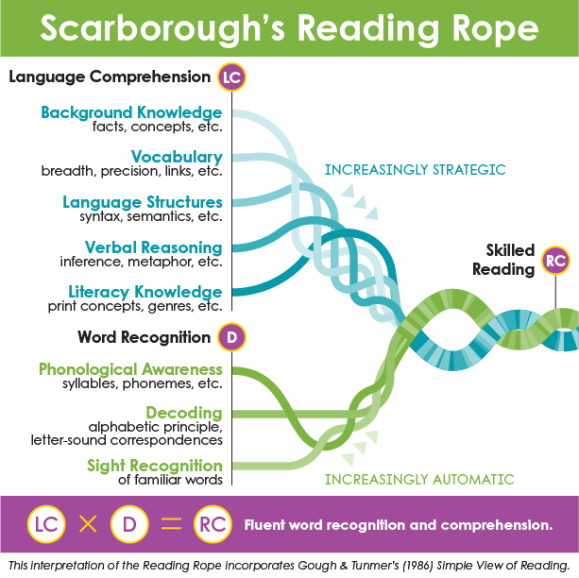
In the early 1990s, Dr. Hollis Scarborough developed the Reading Rope model to help families and educators better understand how reading develops. The model visually demonstrates how multiple literacy skills intertwine over time to produce skilled reading. Published in The Handbook of Early Literacy Research in 2001, Scarborough’s Reading Rope has become one of the most widely used frameworks in literacy education.
Scarborough's Reading Rope is made up of lower and upper strands. When all these component parts intertwine, they result in skilled, accurate, and fluent reading with strong comprehension.
| The Upper Strands Include: | The Lower Strands Include: |
|
|
Scarborough’s Reading Rope aligns closely with the Science of Reading because it illustrates how reading proficiency develops through multiple interconnected skill areas rather than a single instructional approach. The framework emphasizes the importance of explicit instruction in foundational reading skills while also recognizing the critical role of language development, vocabulary, and comprehension.
This model reinforces a key takeaway from literacy research: students need both strong word recognition and strong language comprehension to become successful readers.
Scarborough’s Reading Rope illustrates how word recognition and language comprehension work together to support skilled reading. Explore the research behind evidence-based literacy instruction.
Scarborough’s Reading Rope consists of two major components that gradually weave together to support skilled reading.
Language Comprehension: The Upper Strands
Language comprehension refers to the language and knowledge systems that help students make meaning from text.
Background Knowledge
Background knowledge helps readers connect new information to what they already know. Students with broader knowledge bases are often better equipped to understand increasingly complex texts and build deeper comprehension.
Vocabulary
Vocabulary knowledge plays a critical role in reading comprehension. Students who can connect newly decoded words to words they already know orally are often able to access meaning more efficiently and read with greater confidence.
Language Structures
Language structures include syntax, semantics, and the rules that govern how language works. Understanding sentence structure, word meaning, and language patterns helps students interpret increasingly complex written language.
- Syntax - The arrangement of words in a phrase or sentence. The English language has patterns and rules for the way we order our words. It also has some flexibility and variety in acceptable patterns, and even then, speakers and writers are allowed some leeway with these patterns.
- Semantics - In linguistics, semantics is the study of the meanings of morphemes, words, phrases, and sentences. Knowledge of the meaning of a text is essential to reading.
Verbal Reasoning
Verbal reasoning supports students' ability to infer, interpret figurative language, recognize relationships between ideas, and make meaning beyond literal text.
- Inference - a conclusion one can draw from known facts or evidence.
- Metaphor - a word or phrase used to say that something is another thing in order to suggest that they are similar.
Literary Knowledge
Literacy knowledge includes print concepts, text structures, genres, and an understanding of how written language functions.
- Print Concepts - letters vs. words, 1:1 correspondence, reading left-to-right and top-to-bottom, spaces between written words, letter order matters, etc.
- Genres of Literature - different types of books or stories defined by special characteristics.
Word Recognition: The Lower Strands
Word recognition includes the foundational skills that allow students to recognize words accurately, automatically, and efficiently.
Phonological Awareness
Phonological awareness involves recognizing and manipulating the sound structures of spoken language, including words, syllables, onsets, rimes, and phonemes. Strong phonological awareness supports later decoding and reading development.
Decoding
Decoding is the ability to apply sound–symbol relationships to read unfamiliar words accurately. Explicit decoding instruction helps students develop the automatic word recognition needed for fluent reading.
Sight Recognition
Sight recognition refers to the ability to read words accurately and effortlessly through stored word knowledge. This process is supported by orthographic mapping, which enables readers to anchor words in memory for rapid retrieval. Literate adults have a sight word memory of 30,000 to 70,000 words. Starting in 3rd grade, skilled orthographic mappers are estimated to anchor 10-15 new words a day into their sight-word memories. Sight word recognition is foundational to fluent reading.
- Skilled reading develops through word recognition and language comprehension
- The Reading Rope aligns closely with the Science of Reading
- Upper and lower strands strengthen and connect over time
- Strong literacy instruction supports both decoding and meaning-making
- The framework can inform instruction, intervention, and literacy planning
How does Scarborough’s Reading Rope connect to the Science of Reading?
Scarborough’s Reading Rope aligns closely with the Science of Reading because it illustrates how multiple evidence-based literacy skills contribute to reading development. The framework emphasizes that students need both strong foundational skills and strong language comprehension to become successful readers.
Is Scarborough’s Reading Rope the same as the Simple View of Reading?
No. While both frameworks explain reading development, Scarborough’s Reading Rope provides a more detailed breakdown of the skills that contribute to word recognition and language comprehension. Many educators use the two frameworks together to understand skilled reading more deeply.
Why is Scarborough’s Reading Rope important for literacy instruction?
Scarborough’s Reading Rope helps educators recognize that reading success depends on more than a single skill area. Students need strong decoding abilities, but they also need vocabulary, background knowledge, oral language, and reasoning skills to understand increasingly complex text.
How can teachers use Scarborough’s Reading Rope in the classroom?
Teachers can use Scarborough’s Reading Rope to identify skill gaps, guide instructional planning, and build balanced literacy instruction that supports both foundational reading skills and language development. The framework can also help schools strengthen intervention, curriculum planning, and instructional alignment.
How does Scarborough’s Reading Rope connect to oral language and vocabulary development?
Several upper strands of Scarborough’s Reading Rope directly relate to language development, including vocabulary, language structures, verbal reasoning, and background knowledge. Strong oral language and vocabulary development support students’ ability to understand, discuss, and make meaning from increasingly complex text.