
What Is a Sound Wall?
How Sound-Spelling Walls Support Reading and Spelling
Sound-spelling walls help students connect speech to print by organizing sounds and spelling patterns in a way that supports phonemic awareness, phonics, orthographic mapping, and spelling. Understanding how sound walls work can help educators create stronger connections between oral language and literacy instruction.
Children learn spoken language long before they learn to read and write. Before students can connect letters to sounds, they must first be able to hear, identify, and produce the sounds of spoken language. This speech-to-print understanding is an important principle of Science of Reading-aligned instruction. Reading and spelling are built upon spoken language, making it essential for students to develop awareness of speech sounds and how those sounds connect to print.
Sound-spelling walls support this process by helping students visualize the relationship between phonemes (sounds) and graphemes (spellings). Rather than beginning with letters, sound-spelling walls begin with the sounds students already know from spoken language and connect those sounds to the letters and spelling patterns used in reading and writing.
Traditional word walls and sound-spelling walls both support literacy instruction, but they are organized differently and serve different purposes. Traditional word walls typically organize words alphabetically. Students use them as references when reading and writing.
Sound-spelling walls organize information by speech sounds. This structure helps students connect what they hear to what they see in print, making them particularly useful for phonics and foundational skills instruction.
For example, a student looking for help spelling the word train may not know which letters to use. A traditional word wall organized by letters may provide limited support. A sound-spelling wall allows the student to identify the sounds in the word and explore possible spelling patterns for those sounds.
Because sound-spelling walls begin with speech, they align more closely with how students develop phonemic awareness, decoding, and spelling skills.
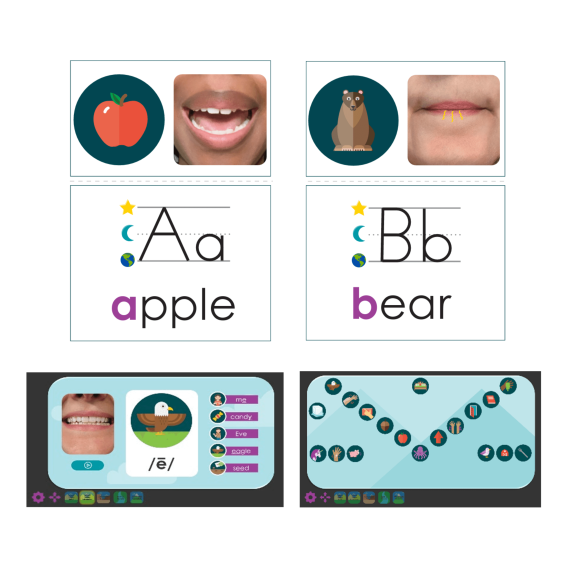
A sound-spelling wall is a classroom resource that organizes speech sounds and the spellings that represent them. Unlike traditional word walls, which are organized alphabetically, sound-spelling walls are organized around phonemes. Each sound is paired with the letter or letter combinations that can represent it. Many sound-spelling walls also include mouth pictures or articulation cues that help students understand how sounds are physically produced.
By making these connections visible, sound-spelling walls support:
- phonemic awareness
- phonics instruction
- decoding
- encoding (spelling)
- orthographic mapping
- word recognition
Sound-spelling walls serve as an instructional tool rather than simply a classroom display. Students can actively use them during reading, writing, and spelling activities to strengthen their understanding of sound-spelling relationships.
Understanding a sound wall is just the first step. Learn how sound walls compare to traditional word walls and why many educators are making the shift to speech-to-print instruction.
Articulation refers to how speech sounds are physically produced using the lips, tongue, teeth, vocal cords, and airflow. When students understand how sounds are formed, they often become better able to distinguish between similar sounds and identify them in spoken words.
For example, students may confuse sounds such as /f/ and /th/ because they sound similar. Looking at mouth positions can help students recognize important differences in how those sounds are produced.
Many sound-spelling walls include mouth pictures that provide visual support for articulation. These visuals help students connect what they hear, feel, and see when producing speech sounds. This additional layer of support can be particularly helpful for students who are developing phonemic awareness, learning English, or experiencing reading difficulties.
One of the primary goals of reading instruction is helping students develop automatic word recognition. This happens through a process called orthographic mapping. Orthographic mapping occurs when students connect the sounds in a word to the letters and letter patterns that represent those sounds. Over time, these connections become stored in memory, allowing students to recognize words instantly and automatically.
Sound-spelling walls support orthographic mapping by making sound-spelling relationships visible.
For example, students may learn that the long /a/ sound can be represented in multiple ways:
- a_e as in cake
- ai as in rain
- ay as in play
Understanding these spelling patterns helps students decode unfamiliar words, spell more accurately, and build a larger orthographic lexicon.
As students strengthen these connections, they develop a growing bank of words that can be recognized automatically, supporting both reading fluency and comprehension.
Sound-spelling walls help students understand that many sounds can be represented by more than one spelling pattern. This knowledge is essential for both reading and spelling.
For example, when students encounter the word rain, they can identify the sounds /r/ /a/ /n/, connect the long /a/ sound to the spelling pattern ai, and apply that understanding to other words such as train, brain, and paint.
Similarly, when spelling a word, students can use the sound-spelling wall to explore possible spelling options and make informed choices based on previously learned patterns.
Over time, these repeated opportunities to connect sounds and spellings strengthen students' decoding, encoding, and word recognition skills.
Not all sound-spelling walls are created equal. The Really Great Reading Sound-Spelling Wall was designed to help educators make meaningful connections between speech and print while supporting phonemic awareness, phonics, decoding, encoding, and orthographic mapping.
The wall includes:
- Individual speech sounds organized by phoneme
- Mouth pictures that highlight articulation and sound production
- Common spelling patterns for each sound
- Visual supports that help students connect sounds to print
- Resources that can be referenced during reading, spelling, and writing instruction
Because the wall is organized around speech sounds rather than the alphabet, it encourages students to analyze sounds first and then connect those sounds to spelling patterns. This speech-to-print approach aligns with how students learn to read and spell and supports the development of automatic word recognition.
Rather than serving as a passive classroom display, the Sound-Spelling Wall becomes an instructional tool that students can actively use throughout the literacy block.
Sound-spelling walls do more than organize classroom information. They help students understand how spoken language connects to written language. By supporting phonemic awareness, phonics, articulation, orthographic mapping, decoding, and spelling, sound-spelling walls provide a bridge between speech and print. They help students build the knowledge and connections needed for accurate reading, confident spelling, and automatic word recognition.
When used as an active instructional tool, a sound-spelling wall can become a valuable part of Science of Reading-aligned literacy instruction, helping students connect sounds, spellings, and meaning as they develop into skilled readers and writers.
- Sound-spelling walls organize instruction around speech sounds, helping students connect spoken language to print.
- Unlike traditional word walls, sound-spelling walls support phonemic awareness, phonics, decoding, and spelling through a speech-to-print approach.
- Articulation cues and mouth pictures help students identify, distinguish, and produce speech sounds accurately.
- Sound-spelling walls support orthographic mapping by making sound-spelling relationships visible and accessible during reading and writing.
- When used as an instructional tool, sound-spelling walls help students build stronger sound-spelling connections, automatic word recognition, and literacy skills.