










All Resources

All Resources

Find Your Resource

Filter by:
Parent and child reading together.
Curriculum
Spanish and English Phonics: Bridging Biliteracy
Discover how Spanish and English phonics overlap. Explore teacher tips and strategies to bridge biliteracy, build confidence, and accelerate English Learners’ reading growth.
Learn More
Adolescent reader making a muscle and holding books.
English Learners
Why Language Awareness Matters for English Learners
Learn how language awareness helps teachers anticipate challenges, set realistic expectations, and strengthen literacy outcomes for adolescent English Learners.
Learn More
Teacher assisting student with school work
Curriculum
Why Visual Representations Matter for English Learners
Strategic visual representations of learned words help English Learners connect decoding to meaning, build vocabulary, and strengthen comprehension.
Learn More
Students sitting around each other.
Curriculum
Why Pronouncing Student Names Correctly Matters in the Classroom
A student's name is often one of the first opportunities to build trust, a sense of belonging, and classroom connection. Learning and pronouncing student names correctly may seem small, but it can shape how students experience identity, respect, and inclusion from day one.
Learn More
Child reading with parent and sibling
Science of Reading
The Science of Everything
Regarding literacy, there seems to be a “science of” everything everywhere you look. Let’s unpack the history, definitions, and interconnected nature of the many sciences that shape literacy and learning.
Learn More
Woman and young girl practicing oral language.
Oral Language
Rethinking Literacy Instruction: The Science Behind Oral Language Development
Oral language development plays a critical role in literacy acquisition. Research underscores that strong oral language skills contribute significantly to reading comprehension, vocabulary expansion, and overall academic success. By prioritizing oral language instruction, educators can foster improved reading outcomes and deeper student engagement with complex texts.
Learn More
Adolescent reader making a muscle and holding books.
Oral Language
Seven Ways Strong Oral Language Skills Boost Adolescent Performance
Oral language skills are the foundation for academic success. Children who develop strong speaking and listening abilities in early childhood often excel in middle and high school. Meanwhile, weak language skills can lead to difficulty in comprehension, writing, and subject mastery. Here are seven ways that strong oral language skills help students as they progress through school.
Learn More
Children reading books in classroom.
Oral Language
Classroom Strategies to Strengthen Oral Language Skills
Oral language supports far more than classroom conversation. It plays an important role in vocabulary development, language comprehension, literacy learning, and students’ ability to express ideas clearly. These four classroom strategies can help educators strengthen oral language skills through purposeful, everyday instruction.
Learn More
Woman and young girl practicing oral language.
Oral Language
District Leadership Edition: Strategies for Oral Language Development in Literacy Instruction
Strong literacy instruction starts in the classroom, but district-level policies, professional development, and resource allocation are critical in ensuring school consistency and effectiveness. Oral language development is often overlooked in literacy frameworks, yet it is a key predictor of reading comprehension, fluency, and academic success.
Learn More
Male student reading a book.
Oral Language
Five Ways Oral Language Creates Confident Readers
Scarborough’s Reading Rope reveals that reading mastery combines two essential strands: word recognition (phonics and decoding) and language comprehension (vocabulary, background knowledge, and syntax). To foster full literacy development, students need to be exposed to rich language experiences that build comprehension, ensuring they don’t just read words but truly understand and engage with them.
Learn More
Woman with child, learning oral language.
Oral Language
How Can Early Oral Language Screening Close the Achievement Gap?
Research shows that early language difficulties are strongly linked to later struggles in literacy, numeracy, and social development. Identifying these challenges early is crucial in preventing long-term academic and behavioral issues. Children with undiagnosed language challenges may experience significant disadvantages in academic achievement and social well-being without intervention.
Learn More
Woman and child practicing oral language into a mirror.
Oral Language
Five Reasons Why Oral Language Skills Are Valuable
Talking and listening are crucial to learning and connecting. Conversations, storytelling, and playful back-and-forth exchanges help kids build vocabulary, understand what they hear, and develop critical thinking skills.
Learn More
Home Connection

Really Great Reading’s Home Connection provides families with the necessary tools to reinforce the learning beyond the classroom.

Really Great Reading: Family Engagement Overview

Engaging Learning Videos

Short videos cover key topics like syllables, reading strategies, and decoding longer words.

Helpful Resources

Letter Tile Free Play, Heart Word Magic, and materials for Countdown, Blast, and HD Word align with classroom learning.
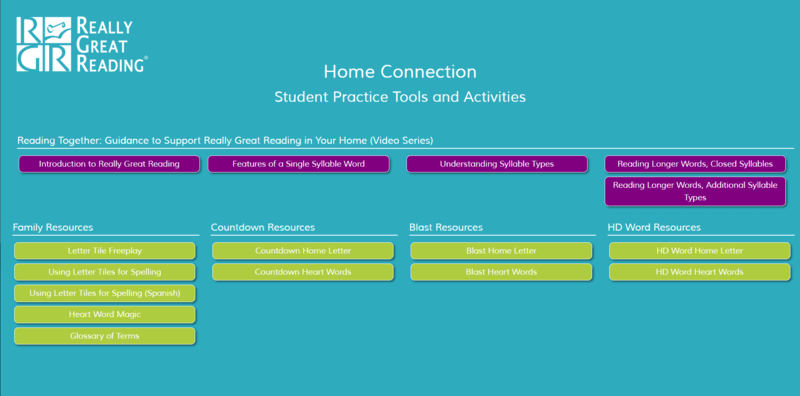
 

Home Connection start screen