
Upper Elementary Reading Intervention for Grades 3-5
Support older struggling readers with targeted intervention that addresses decoding, fluency, vocabulary, morphology, and comprehension gaps.
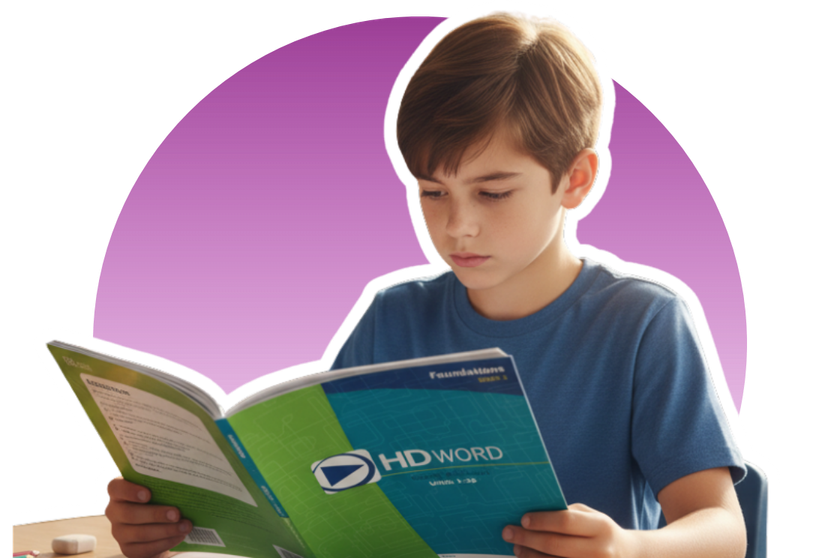

Upper elementary reading intervention supports students in grades 3–5 who struggle with decoding, fluency, vocabulary, language comprehension, or understanding grade-level text.
Often called the 4th grade slump, these challenges become more visible as texts grow more complex and students are expected to read for meaning across subjects.
Effective intervention identifies the specific skill gaps that hold students back and provides targeted instruction to help them move from reading words to understanding text.
They may read slowly, avoid reading aloud, guess at longer words, struggle with multisyllabic words, or show weak spelling patterns.
They may decode accurately but struggle to summarize, explain, infer, or understand academic vocabulary and content-area text.
Students may need connected instruction that builds word recognition, word knowledge, and comprehension together.
Connect with us today to bridge the implementation gap and bring Science of Reading-aligned solutions to your classrooms.
RGR helps educators understand whether students need support with decoding, fluency, vocabulary, morphology, or a combination.
Instruction is aligned to what students need—from multisyllabic word reading and advanced phonics to morphology, vocabulary, and academic language.
Students apply word-reading and word-knowledge skills to increasingly complex text, so intervention supports real reading growth.
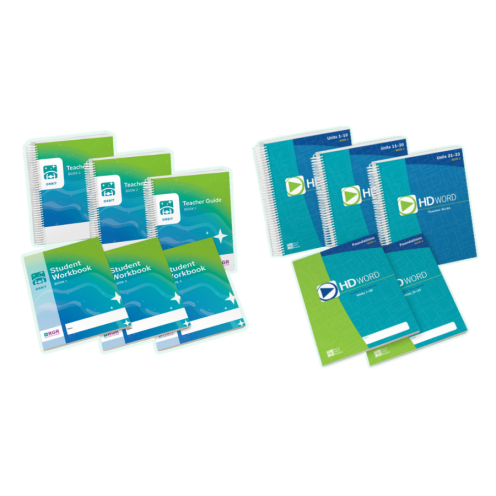
RGR's upper elementary programs, HD Word and Orbit, support different parts of literacy development, working together to help students move from accurate word reading to comprehension. HD Word builds advanced decoding skills, while Orbit reinforces multisyllabic word fluency and builds the morphology, vocabulary, and language comprehension skills that help students unlock meaning from complex text.
Access the Scope & Sequence documents to see how RGR's upper elementary instruction progresses from decoding multisyllabic words to building vocabulary, language comprehension, and meaning.
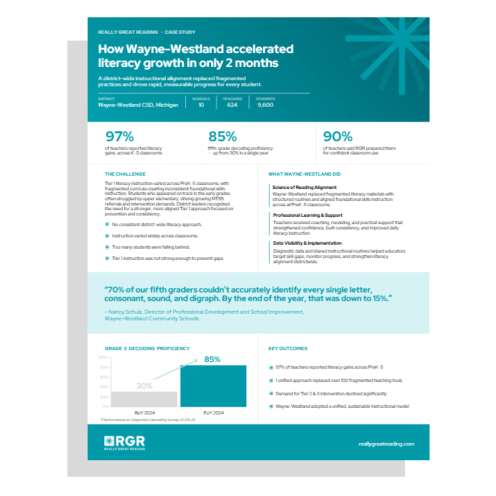
Wayne-Westland created a more connected approach to literacy instruction—helping educators identify reading gaps earlier and improve consistency across classrooms.
The challenge:
Inconsistent literacy outcomes and limited visibility into whether students were struggling with decoding, fluency, vocabulary, or comprehension.
The approach:
A unified literacy system that connected structured instruction, diagnostic data, and targeted intervention.
The result:
Stronger implementation consistency and measurable literacy gains across classrooms.
- Helps educators identify the underlying reading gaps
- Builds both word-reading and language comprehension skills
- Gives teachers explicit, structured routines
- Supports consistent intervention across classrooms and schools

If your grades 3–5 students are struggling with reading, the first step is understanding whether the barrier is word reading, fluency, vocabulary, morphology, comprehension, or a combination of needs.
RGR’s programs consistently meet the highest standards for literacy instruction:
- EdReports awarded RGR all green, near-perfect scores for alignment, usability, and instructional quality
- Evidence for ESSA recognizes RGR programs for demonstrated improvements in student literacy outcomes
- ESSA Tier II studies show RGR programs accelerate student progress across classrooms
- The Reading League's review found no “red flags” across the skills RGR's programs target
- Rivet Education certifies RGR in the Professional Learning Partner Guide for high-quality educator PD
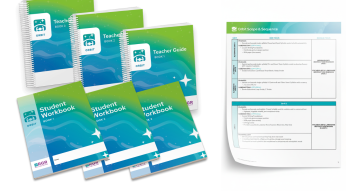


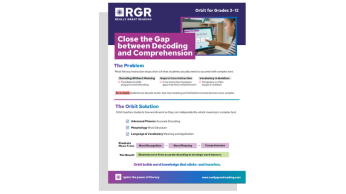
A quick look at how Orbit connects word reading to comprehension. See how aligned instruction drives stronger, more consistent outcomes.

Go inside Orbit and see how decoding, morphology, and language work together to build comprehension. Learn what is missing and how to fix it.
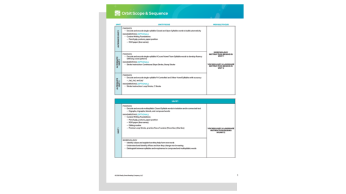
See how skills build from phonics to morphology, vocabulary, and language in a clear progression. Designed to move students from accurate reading to real understanding.
If you’d like to explore how RGR can support your students, we’d be glad to connect.
What is the 4th grade slump?
The “4th Grade Slump” is a well-documented phenomenon where students who appeared to be making adequate reading progress in the early grades suddenly experience a significant decline in literacy achievement and motivation around age nine or ten.
This slump occurs because of a fundamental shift in the nature of schooling and text complexity
Why do some 4th and 5th graders read the words but not understand the text?
It is a common and frustrating challenge: a student reads a passage fluently and accurately, yet cannot answer basic questions about what they just read. This "comprehension gap" often stems from what is known as the "illusion of fluency," where a student has mastered basic phonics but must exert so much cognitive energy on word recognition that they have no mental resources left to process meaning. When decoding isn't yet automatic or effortless, the critical bridge to deep understanding remains blocked.
Beyond simple fluency, a significant morphology gap often emerges in upper elementary as text complexity shifts from familiar words to complex, multisyllabic academic language. Students who can decode simple words often lack the ability to break down the roots, prefixes, and suffixes needed to unlock the meaning of the 60% of new words they encounter in content areas like science and social studies. Even if they can "sound out" a word, comprehension will still fail if the student lacks the background knowledge or Tier 2 academic vocabulary required to translate those sounds into a clear mental image.
How do I know if a student needs decoding support or comprehension support?
To determine whether a student requires decoding support or comprehension support, educators must look past the "surface level" of reading and identify where the breakdown in meaning occurs. A simple way to diagnose this is through a read-aloud versus listen-aloud comparison. If a student struggles to understand a text when reading it independently but can accurately answer questions when that same text is read to them, the issue is almost certainly decoding. In this case, the student’s cognitive "bandwidth" is being entirely consumed by the mechanical act of sounding out words, leaving no room for meaning. Conversely, if a student can read fluently but still fails to understand the content—or if they also struggle to understand the text when it is read aloud to them—the gap likely lies in language comprehension, background knowledge, or vocabulary.
Another key indicator is the student’s performance as text complexity increases in upper elementary. Students who need decoding support often hit a wall when encountering multisyllabic, academic words because they lack the morphological awareness to break down roots, prefixes, and suffixes. If a student is "guessing" at long words based on the first few letters or skipping them entirely, they require targeted word-study intervention. On the other hand, students who need comprehension support often struggle with the abstract nature of the text rather than the words themselves. They may decode the word "metamorphosis" perfectly but lack the mental schema to understand the biological process it describes. By using diagnostic tools like a decoding survey alongside comprehension assessments, you can pinpoint whether to focus on strengthening the foundational bridge of word recognition or building the "upper strands" of language and background knowledge.
Is phonics still appropriate for upper elementary students?
Yes, phonics—specifically advanced word study and morphology—is absolutely appropriate and often essential for upper elementary students. While the "early phonics" of kindergarten focuses on simple letter-sound correspondences like cat or hop, the literacy demands of grades 3–12 shift toward multisyllabic academic language. Many students who appear to be "reading" are actually struggling with an underlying decoding gap that only becomes visible when they encounter the complex, information-dense texts of science, social studies, and literature. Without continued, age-respectful instruction in how words are built, these students often hit a "literacy ceiling" where they can no longer keep pace with the curriculum.
For older students, the focus of phonics evolves into morphology, which is the study of the meaningful parts of words (roots, prefixes, and suffixes). Research shows that by the time students reach the 4th or 5th grade, over 60% of the new words they encounter are multisyllabic and morphologically complex. Teaching an older student that "re-" means again or that "-struct-" means to build provides them with a "power tool" for decoding and comprehension that simple memorization cannot offer. When we provide this type of structured word study, we aren't "re-teaching" primary skills; we are giving older learners the sophisticated linguistic keys they need to independently unlock the meaning of high-level academic text.
What reading intervention works best for older struggling readers?
The most effective intervention for older readers is one that is age-respectful, explicit, and structured. Unlike early elementary programs that use "cute" illustrations, older students need sophisticated, high-interest materials that don't feel like "baby work." The intervention must move quickly from basic phonics to advanced word study, focusing on the multisyllabic words found in their actual grade-level textbooks. Research shows that for these students, a "speech-to-print" or structured literacy approach—one that emphasizes the logic and patterns of the English language—is far more effective than repetitive memorization or leveled reading.
Really Great Reading addresses this need through two targeted solutions: HD Word and Orbit.
HD Word provides the high-level foundational "engine" for students in grades 2–12 who have gaps in phonemic awareness and phonics. It uses a fast-paced, sophisticated approach to teach the multisyllabic decoding skills necessary for students to handle complex, grade-level text.
Orbit picks up where traditional foundational instruction ends, specifically bridging the gap between decoding and deep comprehension for students in grades 3–12. It moves students beyond "sounding out" words by integrating morphology and semantic reasoning, ensuring they don't just read the words on the page but independently unlock their meaning.
Together, these programs transform intervention from a remedial experience into a powerful path toward secondary-level literacy.
Why is morphology important in grades 3–5 reading intervention?
Morphology is the study of the meaningful parts of words (prefixes, suffixes, and roots), and it is the "secret weapon" for upper elementary literacy. By grade 3, the majority of new words students encounter are multisyllabic. Teaching a student to decode "struct" (meaning to build) allows them to independently unlock a massive family of words, such as construction, instruction, structure, and destruction. This shift from letter-by-letter decoding to unit-by-unit analysis allows students to process complex text faster and provides a direct bridge to understanding academic vocabulary.
How does vocabulary affect reading comprehension in upper elementary?
In upper elementary, vocabulary and comprehension are inextricably linked. As students move into content-area reading (science and social studies), they encounter Tier 2 academic words that are rarely used in everyday speech. If a student can decode the word "evaporate" but doesn't know what it means, comprehension fails. Vocabulary acts as the "mental glue" that allows a student to stick new information to their existing background knowledge. Without a robust mental thesaurus, students hit a "comprehension ceiling" where their ability to sound out words exceeds their ability to understand them.
Really Great Reading addresses this "ceiling" through InferCabulary, our digital solution designed to build deep, transferable word knowledge. Instead of relying on rote memorization or single-definition drills, InferCabulary uses semantic reasoning. Students are presented with multiple images representing a single word in various contexts, forcing them to "infer" the meaning. This process mimics how avid readers naturally acquire language and ensures that students don't just recognize a word, but truly understand its nuances. By integrating InferCabulary into the literacy block, educators provide the vocabulary bridge necessary for students to move from successful decoding to deep, independent comprehension of complex texts.
What should a grades 3–5 reading intervention include?
A comprehensive upper elementary intervention must address both the "bottom" and "top" of the reading rope. It should include Advanced Word Study to tackle multisyllabic decoding, Morphology to build semantic connections, and Vocabulary Instruction that teaches students how to use context to determine meaning. Additionally, it must include Fluency Practice with age-appropriate, complex texts and Comprehension Strategies that focus on building background knowledge and verbal reasoning. Most importantly, it should be data-driven, allowing teachers to target specific gaps without wasting time on skills the student has already mastered.
Really Great Reading provides a complete ecosystem to meet these requirements through a suite of integrated solutions.
HD Word: Focuses on the "Word Recognition" strands by providing students with the advanced phonics and phonemic awareness routines needed to decode multisyllabic words with speed and accuracy.
Orbit: Directly bridges the gap between decoding and comprehension. It moves students into high-level Morphology and word analysis, teaching them how to unlock the meaning of the academic language they encounter in content-area textbooks.
InferCabulary: Strengthens the "Language Comprehension" strands by using semantic reasoning to build Tier 2 vocabulary. It ensures students develop the deep word knowledge necessary to understand complex texts across all subjects.
Diagnostic Assessments: RGR’s data-driven approach starts with our grouping matrix and diagnostic surveys, ensuring that instruction is precisely matched to student needs, whether they require foundational support or advanced comprehension strategies.
By combining these tools, schools can deliver a structured literacy intervention that is both rigorous and age-appropriate for the upper elementary learner.
How can schools support students with both decoding and comprehension gaps?
Supporting students with dual gaps requires a multi-pronged approach that doesn't sacrifice one skill for the other. Schools should provide Parallel Instruction: while students spend time in a structured literacy group to "fix" the decoding engine, they must simultaneously be immersed in rich, high-level oral language and background-knowledge building. This can be achieved through audiobooks, teacher read-alouds, and collaborative discussions that allow students to develop their "comprehension muscles" while their decoding skills catch up. RGR Programs like Orbit are specifically designed to weave these two strands together, teaching word analysis and meaning at the same time.
How does RGR support upper elementary intervention?
Really Great Reading supports upper elementary through our Orbit and HD Word programs, which are engineered specifically for the transition from "learning to read" to "reading to learn." We provide teachers with explicit, scripted routines and digital animations that make advanced word study and morphology easy to deliver. Our system includes diagnostic assessments that pinpoint exactly where a student’s decoding or comprehension is breaking down, followed by targeted lessons that bridge that gap. By combining sophisticated, age-respectful content with a systematic, Science of Reading-aligned framework, we help districts ensure that every student in grades 3–12 develops the deep word knowledge required for secondary success.