Welcome to the Science of Reading Hub
Explore the research behind how students learn to read, the skills that support skilled reading, and evidence-aligned approaches to literacy instruction.

Give your team a fresh way to revisit crucial pieces of the Science of Reading. These three on-demand trainings explore reading, vocabulary, and morphology, making it easy to refresh your own knowledge, share focused learning with teachers, or build the series into professional learning.
The Science of Reading is a comprehensive body of research on how students learn to read and which approaches support effective reading instruction. Drawing from education, psychology, linguistics, neuroscience, and other fields, this research provides the foundation for understanding key reading concepts, terminology, and evidence-based literacy practices.
Put Science of Reading research into practice with a toolkit designed to help district and building leaders align instruction, assessment, intervention, and professional learning across schools.
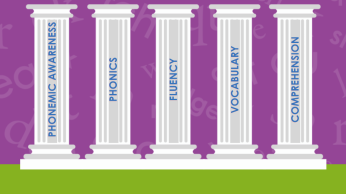
Learning to read is complex. Students must learn to recognize words accurately and automatically while also building the vocabulary, knowledge, and language skills needed to make meaning from text. These areas develop together over time and become increasingly important as reading demands grow.
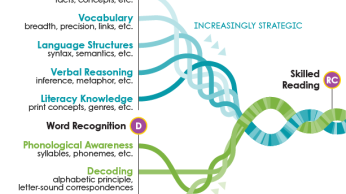


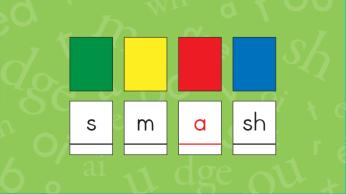
Foundational literacy skills give students the tools they need to read words accurately, efficiently, and with growing independence. Phonemic awareness, phonics, decoding, spelling, orthographic mapping, and fluency work together to help students connect spoken language to print and build automatic word recognition.


Reading the words is only part of the work. Students also need strong vocabulary, background knowledge, oral language, syntax, and verbal reasoning to understand what they read and make sense of increasingly complex text. When comprehension breaks down, looking closely at these language demands can help educators identify where students need support.





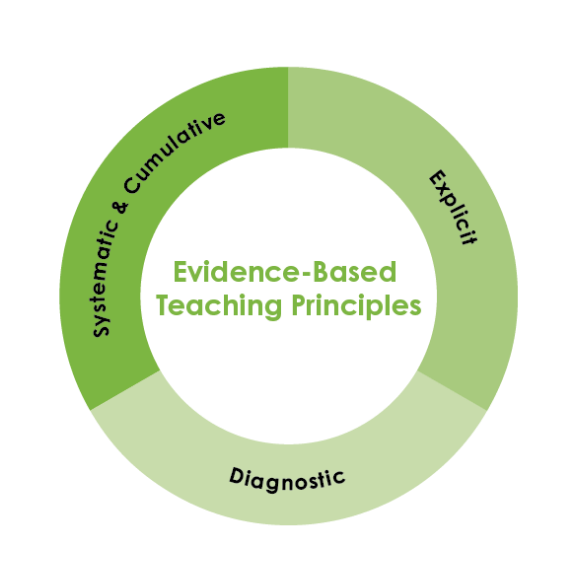
Structured Literacy gives educators a clear, evidence-aligned approach to teaching reading skills. Instruction is explicit, systematic, cumulative, and responsive, helping students build new learning step by step while giving teachers clear opportunities to model, practice, check understanding, and adjust instruction.
Effective assessments give educators a clearer picture of a student’s reading strengths and needs. Screening identifies risk, diagnostic assessment uncovers specific skill needs, and progress monitoring shows how students respond to instruction.


Connect with us today to bridge the implementation gap and bring Science of Reading-aligned solutions to your classrooms.
What is the Science of Reading?
The science of reading is a body of research that incorporates insights and research from disciplines that include developmental psychology, educational psychology, cognitive science, and cognitive neuroscience. The science of reading has been documented around the world, in all languages and cultures, in studies that cost hundreds of millions of dollars. In short, the science of reading has demonstrated the methods that best help children learn to read, from the earliest steps in spoken language to being able to successfully decode unfamiliar words.
What does structured literacy mean?
Structured Literacy is a highly organized, explicit, and systematic approach to reading instruction that is based on the Science of Reading. It is designed to take the guesswork out of learning to read by teaching students the underlying structure of the English language. Unlike "balanced literacy," which often encourages students to use pictures or context to guess words, Structured Literacy ensures that every student has the tools to decode and understand text independently.
The hallmark of this approach is that it is explicit—meaning concepts are clearly explained rather than left for students to "discover"—and systematic, following a logical scope and sequence that moves from simple to complex skills.
The Core Elements of Structured Literacy
To be truly effective, a Structured Literacy program must address these key linguistic areas:
Phonology: Developing an awareness of the sound structure of spoken words (phonemic awareness).
Sound-Symbol Association: Teaching how those sounds map to specific letters or letter combinations.
Syllable Instruction: Understanding the six basic syllable types to help students break down multisyllabic words.
Morphology: Studying the meaningful parts of words, such as roots, prefixes, and suffixes.
Syntax: Learning the grammar and mechanics of how words are put together to form sentences.
Semantics: Focusing on meaning and how vocabulary and context shape comprehension.
Why It Matters Structured
Literacy is essential for students with dyslexia or other learning gaps, but research shows it is the most effective way for all students to learn. By integrating these elements through multisensory, data-driven routines—like those found in HD Word and Orbit—educators can bridge the "implementation gap" and ensure that every student develops the deep word knowledge and comprehension skills required for lifelong literacy success.
What is the implementation gap?
The Science of Reading implementation gap refers to the difference between adopting evidence-based literacy practices and consistently applying them in classrooms.
Many states and districts have taken important steps—passing policies, selecting curriculum, and investing in professional learning. But adoption alone does not guarantee impact.
Without strong implementation, even the most well-aligned materials fail to translate into improved student outcomes.
Why are literacy outcomes still uneven?
Literacy outcomes remain inconsistent because adoption is often undermined by fragmented professional learning and a lack of instructional consistency across classrooms. This "implementation gap" is further widened when assessment data isn't directly tied to instruction, teacher knowledge remains superficial, and intervention efforts overlook the critical needs of older struggling readers. Without a unified system that connects training, curriculum, and data, even the most evidence-based practices fail to deliver measurable results.
What should districts look for in a literacy program?
To improve literacy outcomes, districts must move beyond simple "Science of Reading alignment" and look for a unified system designed to bridge the implementation gap. A high-quality program should provide a cohesive infrastructure where curriculum, professional learning, and data-driven insights work in lockstep to ensure every teacher can deliver effective instruction.
Why do students still struggle with decoding in grades 3–5?
The transition from 3rd to 5th grade is often where underlying decoding gaps finally become visible. While students may have appeared to be reading "well enough" in the primary grades, the shift in text complexity often reveals that they were relying on memorization or guessing rather than true word-level mastery.
Students in the upper elementary grades typically struggle with decoding for three primary reasons:
1. The "Hidden" Decoding Gap
In K–2, many students "mask" poor decoding skills by using context clues, pictures, or memorizing high-frequency words. However, as they reach 4th grade, those supports disappear. Texts become longer, pictures vanish, and the volume of unfamiliar words increases. Students who never fully mastered the phonics "engine" suddenly hit a wall because they can no longer guess their way through the curriculum.
2. The Multisyllabic Shift
Early literacy instruction focuses heavily on single-syllable words (e.g., cat, ship, best). In grades 3–5, over 60% of the words students encounter are multisyllabic academic terms (e.g., atmosphere, biological, infrastructure). Students who lack a systematic way to break words into syllables or identify morphological roots often skip these words entirely or guess based on the first few letters, which directly destroys their comprehension.
3. Lack of Advanced Word Study
Most standard literacy programs stop formal phonics instruction at the end of 2nd grade. This creates an "instructional gap" for students who haven't yet reached automaticity. Without explicit instruction in Advanced Word Study and Morphology, these students never learn the logic behind complex English spelling patterns, leaving them stuck with a 2nd-grade reading foundation while being asked to do 5th-grade work.
How We Fix It
To solve this, intervention must be age-appropriate and fast-paced. Really Great Reading’s HD Word and Orbit are specifically designed to address these "missing links." By teaching students the advanced phonics and morphological structures needed to decode multisyllabic words, we provide them with the "power tools" they need to move past guessing and gain the independence required for secondary-level success.